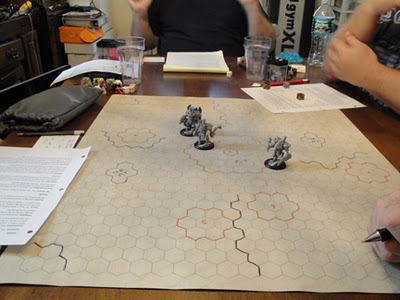
We’re a day late and a dollar short on this post. Please excuse us; it’s been that sort of week.
 I can think of no better way to close out the School’s Out Week than by turning our attentions towards what many consider the poster boy for “what went wrong”: 4th Edition D&D. I’ve had time to weigh the pros and cons of the latest incarnation of the venerable roleplaying title due to my recent (and highly unforeseen) involvement with the title.
A few weeks ago, one of my Labyrinth Lord players announced that he’d be orchestrating the D&D Encounters program at our FLGS and he kindly invited me to attend. He was well aware of the fact that I’m firmly in the school of “less is more” and that 4E is really not my “go to” edition for D&D (he said, understating the subject), but left the offer open. When the next Wednesday rolled around, I stopped by to make sure he had enough players to go through with the matter. Having experienced what it takes to get a group of gamers going, I wanted him to succeed and if that meant having to sit in so he’d have enough guys to run, I was willing to do so. And that’s exactly what happened due to some miscommunication with the store about scheduled start times and dates. Thus, Mike took up the role of Brandis the human paladin and set forth to defeat the darkness (literally).
My previous experience with 4th edition was the singular playtest my group ran of D&D Gamma World some months ago. This time, I’d be on the other side of the DM’s screen. Out of respect, I kept my mouth shut and my mind open and did my best to treat it as a roleplaying game and not a miniatures battle game. The results were mixed.
First off, let me say I’m not here today to tear down 4E. I realize that I have no axe to grind anymore, if ever, with WotC. I’ve developed a lot of sympathy for the guys down in the design trenches and have the sneaking suspicion that they’re not really happy with the direction things have taken and would much rather be paid to take the game in another direction. Since a steady RPG design gig is a rare bird, I don’t blame them and might do the same thing in their position.
Also, any criticism that follows is not directed to Dave, who has taken up the challenge of running the Encounters sessions (which is a really bad choice for a name because it sounds too much like the swingers’ group that meets weekly at the A-Frame). He’s running the program they sent him and is inhibited by the material. I also respect anyone who is out there running a game rather than sitting at home bitching about the fact they’re not.
After sitting through two Encounters sessions, I’m ready to speak openly about my experience with 4E. It isn’t much different from the impression I got when running D&D Gamma World and is one I’ve seen repeated in several places. Ultimately, when the books are put away and the chip bowl has been emptied, 4th Edition D&D is a decent skirmish miniatures game. When paired with the weekly, two-hour long Encounters program, it becomes even more engaging. The players have a set goal and know that they’ll be headed home once it’s finished, not unlike putting aside two hours to watch a movie. I can honestly say that I’ve enjoyed the past two weeks.
The Encounters program is obviously geared toward a specific type of gamer, one with limited time and perhaps lacking the means or social skills to cultivate a group on their own. Each session starts with a little light roleplaying that is essentially a guise to determine what this week’s goal is. Are we to defend the orphanage? Kill the bandit chief? Maybe pursue the sinister gnome who ran down the alley into the obvious ambush? Once that’s out of the way, the tactical map is put down, the counters are placed, and the dice start rolling. When the last body hits the ground, you pack up and head on home.
This isn’t a bad way to approach 4E and it is much more enjoyable to me than I suspect participating in an ongoing 4E campaign would be. There is no investment needed other than a small block of time each week. My character is pre-generated and all his powers are neatly written on the back of the laminated character card, so I don’t have to drop a dime on confusing rulebooks (which one is official this week?) or power cards (I’m not spending another $10 because I want to play a warlock this time). I sit down, chuck some dice, and go home. Of course, the downfall to this is that I’m not invested in my character any more than I’d be with my race car piece in a game of Monopoly. This takes me to my real difficulty with 4E.
I cannot lose myself in the game the way I can with older editions. This is not the fault of the DM or the adventure, but the rules themselves. The rules in 4E, especially their dependency on creating unambiguous rulings, never disappear into the background for me. I can occasionally erect a thin veneer of roleplaying, but this comes crumbling down the first time I’ve got to start counting adjacent adversaries to see how big of a bonus I get to attack. The most recent WTF moment that threw me completely out of the moment came when I suggested that, rather than expend some out our limited healing surges to recoup after a fight, we return to the chapel we had just come from and ask the priests there if they could drop some of their heavenly mojo on us. That was when I was told that magical healing in 4E is tied to your character’s healing surges and even potions deduct from them. Huh?
For me, 4E simply misses the boat when it comes divorcing oneself from reality and reveling in the shared delusion of roleplaying. I’ve always been a fan of “fluff” over “crunch,” so 4E is like eating a cotton candy cone filled with nails, screws, and broken glass for me; just when I’m trying to enjoy the sweetness, I bite into something that ruins the experience. But also like cotton candy, it’s best when sampled infrequently and in small portions.