Showing posts with label October Country. Show all posts

Saturday, May 12, 2012

The October Country: Swamp Shark

More scavenged material regarding the October Country setting from my other blog. I've gone from "working on a book" to "planning on working on a book once I finish Stonehell 2, but the October Country material still looms large in my head.

I’m working on a book that brings detail to a section of the October Country known as Snakewater Swamp. It’s been a lot of fun and is helping me to focus on certain systems I want to implement in the game and to flesh out the world in greater detail. I won’t say much more in the meantime.

Like the rest of the October Country, the wildlife found in Snakewater is largely of my own creation. For various climatic reasons, gators aren’t nearly as common as they are on Earth, but that doesn’t mean the swamps are free of large, aquatic predators. The swamp shark fits that bill wonderfully and has the pedigree of being inspired by the late-night, Sci-Fi channel cheapy movie of the same name. If you’re going to watch crap, you might as well make the best of it.


Swamp Shark

STR: 4d6+12 (26)
CON: 3d6+6 (20-21)
SIZ: 4d6+12 (26)
INT: 2d6 (7)
POW: 3d6 (10-11)
DEX: 4d6 (14)

Average hit points: 24
Move: 10 (swimming)

Other skills: Hide—50%, Leap from Water—50%, Swimming—95%, Tracking—85%

Damage Modifier: +1d12
Armor: 2 point skin

Attacks
Bite: 50%--1d10+1d12 damage

Swamp sharks are a species of shark that has adapted to the brackish and freshwater conditions found in coastal marshes. Their adaptations allow them to venture further into the headwaters of coastal rivers and bayous and many have begun to use these areas as nurseries for the pups. Full grown swamp sharks range in 8 to 11 feet in length and can weigh up to 700 lbs. Skin tones are brownish-gray to dark green, giving them natural camouflage in the muddy waters of the swamp. Swamp sharks are usually solitary predators (85%) but are occasionally encountered in pairs (15% chance). They attack by rushing their prey from concealment, biting their victim to shear off flesh, and then move past their prey to devour the mouthful of meat. They turn and make another pass two or three rounds later.

Sunday, April 15, 2012

The October Country: Project Sleeping Village

In 1972, the Central Intelligence Agency, working under the auspices of Project MKULTRA, erected a facility fifteen miles outside of Gilead, Maine. This facility consisted of six Quonset hut-style dormitories and five auxiliary buildings. Surrounded by razor wire and guard towers, the purpose of the facility was ostensibly to house an overflow of non-violent criminals incarcerated in the Downeast Correctional Facility in Machiasport. In truth, the site was the home of an illegal C.I.A. human research program designed to stimulate and test psychic phenomenon. This program was dubbed Project Sleeping Village.

When the facility, known as “Town Hall” in declassified records, began operations, one hundred human guinea pigs were transported to the site and installed in the prefab dormitories. These one hundred test subjects came from various sources: federal prisons, college campuses, military bases, and as a result of classified intelligence operations around the globe.

Once inside Town Hall, the subjects were treated with a synthetic chemical known as Chimera, a drug that purportedly caused laboratory animals to exhibit spontaneous psychic talent. Testing of Chimera on the human subjects in Town Hall continued for six months, during which time 17% of the subjects experienced psychotic episodes, 5% lapsed into catatonia, and 1% displayed what was referred to as “anomalous sensory phenomenon.” The cost of these results: $2 million USD or approximately one-fifth of MKULTRA’s operating budget at the time.

Lack of statistically significant results combined with high operating costs doomed Project Sleeping Village and Town Hall was closed down the following year. The site was abandoned for almost a decade before the land and remaining buildings were allotted to the state of Maine and eventually became a summer camp for special needs children. Most of the classified records pertaining to Project Sleeping Village were destroyed in 1973 when CIA Director Richard Helms ordered a purge of all materials pertaining to MKULTRA. A few documents survived destruction, and an even smaller percentage has come into the possession of “interested parties” outside the U.S. Federal Government.

Considered a failure at the time, Project Sleeping Village and Chimera have displayed an unexpected longevity. Although the drug had little effect on developing psychic talents in the initial test subjects, the offspring of the original one hundred have demonstrated an abnormally high predilection for psychic ability. Three in five children with a parent who participated in Project Sleeping Village displayed some sign of extra-sensory talent before the age of ten, with the strength of this ability increasing significantly during puberty. Although no official tally exists, children of “Sleepers” reportedly displayed talents ranging from psychometry, telepathy, cryokinesis, telekinesis, precognition, and biokinesis.

These children are now in their mid to late 30s and can be found scattered around the country and overseas. Because of the broad spectrum of the original test subjects and the destruction of the records relating to Project Sleeping Village, it is virtually impossible to determine who bears the legacy of the that research. One common trait is prevalent, however: anti-social and even sociopathic tendencies brought about by constant abuse and ostracism during adolescence. Anyone dealing with a suspected Village Legacy should exercise extreme caution.

As a related note, recent intelligence reports have determined that a drug based on the original Chimera agent is being developed in nations unfriendly to the West. In twenty years, a new generation of psychically gifted adults could pose a threat to national security; operations to curtail the development of this chemical are currently underway. Those aware of the October Country worry that the drug could cross the barrier, with the results of a psychic stimulator in the Autumnal Lands causing widespread havoc in that magic-rich environment.

Friday, April 13, 2012

The October County: Les Rouge Soeurs

If you spend enough time around the bayas of Snakewater Swamp, sooner or later you’ll hear tales of the loup-garou, a nasty piece of work that haunts the backwaters and lonely roads late at night. Chances are, especially if you’re from Earth, you’re already thinking you know what ol’ loup is. You’d be wrong.

Old loup-garou is a man or woman who went bad...real bad. So bad that when they died, not even Hell wanted a piece of them and so they walk the world of the living, angry, mean, and hungry. You can tell a loup-garou easy: he’s got a wolf’s skull for a head and is wrapped in the burial shroud they put him in the ground in. He’s got long claws and razor-sharp teeth, and he likes nothing more than a dainty bit of woman flesh to chew on. Fact is, old loup will stalk a woman a’fore he’d stalk a man. That’s usually bad news for a woman or girl caught out after dark when he’s on the prowl.

But loup-garou has met his match a few times when he thought he’d spotted a helpless waif alone in the dark. Sometimes it’s due to sheer luck; other times it’s because that helpless maiden was more than she seemed and knew what lurked out in the night. But the worst bit of news for a hungry loup-garou is that the little bit of girl he planned to put the bite on is one of the les Rouge Soeurs.

Nobody can recall who started the les Rouge Soeurs  (otherwise known as the Red Sisters to those who don’t habla the patois of the baya). Nobody outside the Sister that is; those who bear the crimson could tell you, but it ain’t likely unless they’re welcoming you into their krewe—and they’re only doing that if you’re a woman who got one over on old loup-garou.

Les Rouge Soeurs specialized in hunting loup-garou, bringing the fight to those critters with fire, silver, and mirrors. You can recognize one of the Rouge Soeurs by the red cloaks and dyed leather armor they wear. They usually ride chestnuts, sorrels, or palominos when they can find them and seat them with red saddles tooled with silver. Almost all the Sisters carry firearms, but each is a master with a blade as well. They work in teams of five or six, with each krewe responsible for a large region, oftentimes covering many hundreds of miles in area. Each group reports to a superior known as Grand-mère who works to coordinate her team with other krewes of les Rouge Soeurs to hunt down and destroy loup-garou wherever they might lurk.

Les Rouge Soeurs only recruit woman and teenage girls who have survived a loup-garou attack. For many of these victims, the sense of sisterhood offered by membership in les Rouge Soeurs, combined with the skills and tactics they learn upon initiation, helps them cope with psychological trauma they face in the wake of an attack and forges them into self-confident, powerful women. With this empowerment, few have any desire to return to the world and society they knew before they met their monster.

Although they specialize in loup-garou,  les Rouge Soeurs will hunt other dangerous creatures, especially those that victimize the young, old, or defenseless. They have an uneasy relationship with the Rambling Men and occasionally work with one of those travelling troubadours when their interests coincide, but the personalities and the misogynistic attitudes that some Rambling Men have tend to make those partnerships short-lived.

Wednesday, March 14, 2012

The October Country: The Rowan House

The Rowan House could be any one of a hundred bed-and-breakfasts found along the south shore of Long Island but for two exceptions: 1) it is located on a sandspit extending out into the Great South Bay, where despite this somewhat precarious location, the inn survived both the Great Hurricane of 1938 and Hurricane Gloria in 1985 without damage, and 2) it does no advertising. Despite these sizable obstacles to long-term survival and profitability, the Rowan House has been in business for more than a hundred and fifty years.

Built in 1857, the Rowan House is a unostentatious, four story, shingle-style building. Erected at the end of Crab Spit on the western side of Rorkes River, the inn is reachable by both car and boat. A gravel road connects it to the mainland and a well-maintained dock accommodates luxury craft of up to 50 feet in length. The inn overlooks a small salt marsh that is home to an above-average sized population of Black-crowned Night herons and Snowy Egrets.

Over the years, the Rowan House has earned a reputation as a quiet, discreet getaway. Located within the village boundaries of Chattaquogue, Rowan House escapes the media attention normally aimed at the Hamptons, making it the perfect hideaway for the rich and famous looking to avoid the spotlight. The professional staff never reveals the identities of the inn’s guests, a service for which they are well-compensated.

Of course, with such a reputation for secrecy and an unconfirmed but much speculated-upon guest list, the Rowan House has become the center of many rumors over the years. This gossip ranges from tales of dead high-priced prostitutes efficiently disposed of by the inn’s staff in the Great South Bay to rumors of Satanic covens composed of Hollywood and Wall Street elite meeting for sabbats at the House.

The strangest of the rumors, however, is that The Rowan House is the place where the very rich or very desperate can go to reinvent themselves—literally. Hushed rumors state that there exists a power within the inn’s walls that allows those determined enough to become anyone of their choosing. For a day, a week, or even a lifetime, those willing to make the required payment are physically transformed into someone or even something else. Needless to say, this particular tale isn’t taken very seriously by most rumormongers, who prefer to envision the inn as the scene of more mundane but certainly more pornographic indulgences by Hollywood starlets.

Monday, March 12, 2012

Wildwyck County: Paul Strohd, Alternative Historian

A hint at things to come in the Wildwyck series. Again, this entry is set in the modern era, but its roots go back to the 1920s...and beyond.

Throughout New England and New York there are Neolithic anomalies. The most famous of these is Mystery Hill in Salem, New Hampshire, but numerous, less-famous examples exist. Of these lesser sites, many are slab-roofed chambers of stone, some of enormous size. Mainstream archeologists explain away these constructions as Colonial-era root cellars. More controversial historians speculate that they may have served as Native American tombs. Outright crackpots call them evidence of a widespread but undocumented Irish (or Norse, Atlantean, etc.) presence in the area. There is, however, another very unusual theory.

Paul Strohd lives just outside the village limits of Rotskill, New York. A thin, severe-looking man in his mid-fifties, Strohd hardly fits the image of the crazed crank arguing his favorite theory. He is always immaculately dressed and carries himself with an almost old-fashioned grace. He conducts himself in a precise and orderly manner, never succumbing to haste when working at a task. It is for this reason that so many people have difficulty reconciling the man with his work.

Strohd maintains that these Neolithic anomalies are evidence of an undocumented culture in New York and New England, but one that even the alternative history theorists are loathe to embrace. It is Strohd’s belief that these chambers were constructed by beings from another dimension, one that shares permanent yet uncommon connections with Earth. He has written three books on this subject, Uncanny Colonists, Walking Through Walls: A Guide to the Thought Temples of New York State (both self-published), and Ancient Anomalies Explained (Shadows Gather Books, 2004).

Strohd’s theory is that, prior to the arrival of Native Americans to the region, there were several seed colonies settled by extra-dimensional visitors scattered about the Northeast. These beings, dubbed “Exonauts,” arrived on Earth as refugees of a horrendous upheaval in their home dimension. It was their hope to establish dimensional beachheads in this world that would allow others of their species to escape the chaos raging in their native world. Unfortunately, the Exonauts were unable to achieve their plan and either died out or where absorbed by the native tribes when they arrived in the region. Their stone chambers and other anomalies remained untouched as they were considered cursed by the indigenous peoples.

Despite how ludicrous Strohd’s theory sounds, there are some campfire tales that seem to confirm that these sites are home to unexplained phenomenon. White-robed figures, hooded Viking-like entities, cloaked dwarves, and even Sasquatch-esque creatures have been glimpsed in and around these stone chambers. Whether these are the spirits of the long-gone Exonauts, glimpses of their home dimension, or some other phenomenon is, of course, unknown.

Strohd engages in regular speaking tours and is quite popular amongst the New Age crowd. His speaking fees allow him to continue his research and writing while maintaining a frugal lifestyle. This coming summer, he plans to take a three-week foray into the Adirondacks in search of more Exonauts sites and is currently looking for research assistants willing to work for room and board (or in this case, a tent and MREs).

Thursday, March 8, 2012

The October Country: The Cargo Cult

Those residents of the October Country who originally hail from Earth know of the cargo cults that arose in South Pacific following the Second World War. However, those born in the Autumnal Lands are aware of another quasi-religious phenomenon that shares the same name.

Signs of the cult are not common, but do pervade almost every known trade route and method throughout the October Country. On rattling railcars bound for the Lightning Lands, on moss-covered boats plying the Snakewater Swamp, and on the beasts of burden driven by the nuleskinners of the Brackish, the signs are there: parcels, crates, and barrels chipped with travel and bearing any number of near-illegible labels and mystic symbols. Always treated with care, these containers move from town to town, never finding a final address at anyplace they go.

The origin of the cult is uncertain, but scholars have pieced together some background. In his work Transient Religions Under the Frost Moon, Professor Caspar Gellkillerson records the most commonly told tales regarding the cargo cult and is considered the primary reference source for all theologians interested in the study of this religion.

According to Gellkillerson, the cargo cult began when a large packing crate bearing certain High Magic sigils of protection was laden onto a wagon bound for the City of Candles. When the wagon arrived in the city, it was learned that the addressee had died, leaving no next of kin to receive it. The caravan master, as is custom, could claim the crate and all it contained as his own if no legal claimant was found. After a week passed with no such challenger appearing, the caravan master paid a magician to inspect the symbols prior to opening the crate. Upon seeing the glyphs, the magician backed away in fear and warned the caravan master that powerful protective charms were in place, ones that spelled doom for whoever dared to open the box if they were not “of the selected brood.”

The caravan master tried unsuccessfully to pass the crate onto other unsuspecting parties, but they always became aware of the warnings protecting the crate and refused to take it off of his hands. Finally, in desperation, the caravan master had it shipped back to its town of origin, thus beginning a process that continues to this day.

The crate arrived back from whence it came, but the original shipper could not be found. The poor depot clerk who accepted the crate soon found himself in the same situation as the caravan master. It took him two weeks, but he eventually smuggled the crate onto a riverboat headed north and dusted his palms of the problem. In each new place the crate arrived, the process was repeated and the box, now showing signs of wear and tear, and covered with faded shipping labels, continues its endless journey looking for someone “of the selected brood” to take possession of it once and for all.

In time, other containers joined the original crate under similar situations. Some are no doubt “copy cat” shipments sent by pranksters who heard the tale of the crate and mocked up their own with fake sigils and blatantly erroneous addressees, but others bear the same fearful warnings etched upon their wooden exteriors. More telling that these containers were of legitimate origin was the effects produced when two or more crates found themselves in close proximity in a warehouse, riverboat, or railcar.

When multiple containers come near one another, unnatural events occur. Spontaneous growths of vegetation, chilling fog banks, whispered songs sung in unidentifiable tongues, and other happenings have been reported. These so-called miracles were what created the first of the Cargo Cultists—men and women who reported seeing visions, receiving supernatural healing, and other mystical revelations when near the containers. These cultists continue their strange religion, often acting as unofficial (and often unwanted) guardians of these containers as they make their endless journeys. When several containers appear at the same location (always by happenstance for the Cultist never act to guide the boxes on their travels or determine where or when they will arrive), tent revivals spring up to attract the few but fervent believers the Cult has. There, the devoted witness miracles and testify about the coming of the One the Crates are Destined For.

The Cargo Cult is tolerated, mostly because they keep to themselves, pay the costs of keeping the crates moving, and are not a violent or proselytizing sect. They’re nevertheless considered one of the weirder religions in the Autumnal Lands and associating with it adherents (or worse, joining them) is a sure way to damage one’s prestige.

Wednesday, March 7, 2012

The October Country: The Ghost Machine

I'm still banging away on projects and preparing for GaryCon (14 and a wake-up!) so the consolidation of blogs continues. Today's post is all about a strange device that appeared in my dreams.

I mentioned at the end of last year that the October Country material has taken on a sometimes uncomfortable life of its own, making it difficult for me to escape its powerful allure. It is indeed heady stuff to my mind and the autumnal land and its parts have invaded my dreams more than once…or maybe I’m merely travelling there more often in my sleep. The following came from a dream I had two nights ago. I was exploring the attic of a decaying hotel and found this bizarre, unwieldy-looking, antique typewriter there. After blowing the dust off of it and figuring out how it worked, I began having a two-way conversation with the ghost of a murderer. The typewriter model cited in the post below is a different one from my dream, but of all the antique typewriters I could find, it comes closest to the strange device I found in that attic.

The device known in certain circles as the Ghost Machine is unusual in appearance, but not abnormally so. It tends to draw stares not because of the function it can perform, but rather because it is rare to encounter a typewriter in the 21st century—especially one that is more than 100 years old.

Those few individuals knowledgeable of the history of these obsolete business machines recognize the Ghost Machine as being a North’s number 1592, manufactured in London in 1892. The machine (and the company that manufactured it) gets its name from the obscure English lord who financed it. Individuals with more than a passing knowledge of Victorian Era spiritualism know that Lord North held a deep interest in the afterlife, so it comes as no surprise that the Ghost Machine serves as a conduit for the dead.

The Ghost Machine allows for conversation between the living and the dead—even with those who have never demonstrated the slightest talent for mediumship. When using the Ghost Machine to communicate with the dead, PCs with the skill of Medium add a +20% bonus to their percentage. Those without the skill can utilize the device with a base 20% chance of success, modified by other conditions as normal.

The Ghost Machine is simple to use. When a clean sheet of paper is inserted into the typewriter’s “holding basket”, the machine is ready to function. The typewriter’s operator need only type a question onto the paper and wait for a reply. If the Medium skill roll (or the base 20% chance) is successful, and there is a cognizant spirit within a half-mile of the device, that ghost will become aware of the Machine and likely be drawn to its location. Spirits with a POW of 13 or less are compelled to seek out the Machine and its operator; those with POWs of 14 or better will be intrigued but cautious, and may or may not approach the location of the Machine depending on their personalities and goals.

Once present, the spirit can communicate with the living by means of typing out a reply via supernatural manipulation of the Ghost Machine. The Machine seems to operate on its own as the keys strike and the reply appears on the page. Although the typewritten reply is typically in the same ink as the original query, there have been cases where the reply seems to be typed in blood, ectoplasm, or even ordinary water. The ghost must spend one MP for each full minute spent in typewritten correspondence, and once it does, is compelled to answer any question typed during that period. After the minute expires, it can choose to spend another MP or cease conversation. If during the minute period, the Machine’s operator ever types a question the spirit wishes not to respond to, it and the operator must engage in an POW Opposition Test. If the spirit is successful, it can obfuscate the truth or simply not reply.

For unknown reasons, the Ghost Machine tends to attract angry or harmful spirits. If there is more than one spirit within the area affected by an operating Ghost Machine, the most dangerous of the ghosts present will always be the one to make contact. It is for this reason that would-be mediums lacking proper talent and training are cautioned against using the Ghost Machine without proper precautions and supervision.

Friday, March 2, 2012

The October County: The Czech

Like any close group, the counter-intelligence community has its own myths and legends. Ask an old Cold Warrior about the “ninth helicopter of Operation Eagle Claw,” “the thalidomide briefcase,” or “the shark tank drop” and you’d get a knowing chuckle. No answers, but a laugh at least. However, should you ask about “The Czech,” that laughter would abruptly cease. To this day, whenever ex-CIA and former KGB cross paths, one will eventually turn to the other and say, “After all these years, you can finally come clean, Yuri. Tell me: was the Czech one of yours?” The reply is just as unavoidable: “That’s funny, Chuck. I was about to ask you the same thing.”

The man known as the Czech is as close to a boogeyman figure as you’ll find in the world of espionage. Only one photograph of him exists. Taken at Checkpoint Charlie in East Berlin in 1982, it shows a man in his early thirties dressed in a cheap East German suit. A gym bag is held in his left hand, upon which can be seen a fake Rolex and a small scar. His hair is dirty blonde and needs trimming. Steel-rimmed spectacles cover his brown eyes. He looks off to his right, calmly. At that crossing, he presented identification bearing the name “Dušek Czermakov” and showing his place of birth as Jince. It was from this incident that “The Czech,” who may not be Czechoslovakian at all, earned his name.

Since this early, tentative identification, the Czech has had numerous intelligence coups attributed to him by agencies on both sides of the Iron Curtain. When an impenetrable vault is found riffled, its contents missing, blame is placed on the Czech. The crashing of a secure computer network despite bulletproof security bears all the signs of being a “Czech job”, according to experts. As an operative once exclaimed, “It’s as if that asshole walks through fucking walls!” Some say this is actually the case…

The end of the Cold War and the general graying of the operatives who were active during those years should have led to a decline in the Czech’s activities, but that is proving not to be the case. If anything, he has become not only more active, but has enlarged his skill set, engaging in computer hacking, electronic counterfeiting, and black market art deals—if the rumors are to be believed, that it.

Most disconcerting for some are the several seconds of video taken by a CCTV outside the Preston Road tube station in London. This footage, although slightly pixilated, depicts a man in his early thirties wearing a wrinkled suit, a gym bag held in his left hand. Steel-rimmed spectacles cover his eyes and a fake Rolex is strapped to his left wrist. The presence of a scar on that hand is impossible to see due to video quality. Those familiar with the sole photograph of the Czech have been known to blanch when seeing the CCTV footage for the first time.

Although there is little crossover between those active in espionage here on Earth and those aware of the October County, one individual involved on both sides of the barrier attests to seeing the Czech present at a conclave of nobles held in the City of Candles during the earthly year of 1990, making it entirely possible that the Czech may indeed have access to abilities that far outstrip those of his fellow operatives.

Wednesday, February 29, 2012

The October Country: Lantern Frogs

Resembling terrier-sized tree frogs, lantern frogs are multi-colored amphibians that naturally produce a soft, luminescent green glow. This illumination attracts the large insects that the lantern frog preys upon. Lantern frogs can dim their light, but do so poorly and must make a successful Hide roll in order to dampen their glow enough to avoid notice. Otherwise, observers gain a +25% bonus to any Notice roll to detect the frog's presence. In recent decades, lantern frogs have been domesticated and are a favorite pet of the children of nobility, poets, and those that eat taveesh resin.

Lantern Frogs
STR: 2d6 (7)
CON: 3d6 (10-11)
SIZ: 1d4 (2-3)
POW: 3d6 (10-11)
DEX: 3d6 (10-11)

Average hit points: 6
Move: 6 (jump 9)

Skills: Climb 90%, Hide 20%, Dodge 45%, Jump 85%, Notice 65%

Armor: 1
Attack: None, but when panicked, Lantern Frogs produce a burst of light that can temporarily blind predators. A successful POW vs. POW Opposition roll indicates the observer is blinded for 2d6 rounds.

Friday, February 24, 2012

October Country: It's the Little Things

I'm still consolidating the Secret Antiquities material into the Society of Torch, Pole and Rope. This first appeared on October 23rd, 2010.

Standing on line last night for a haunted house attraction, a discussion arose regarding preferences for horror films. It quickly became obvious that, of our group anyway, the preference was on “less is more.” There were no gore aficionados amongst us. I’ve stated on a previous occasion that my favorite horror film is the original The Haunting because all the heavy scare work is done by your own imagination and not CGI or foam latex appliqués.

This morning, I watched The Grudge for the first time. In doing so, I found myself getting caught up in the minutia of the film: the little things that, when placing myself in the same situation, I found more disturbing than all the creepy dead-eyed children and stray follicles. I thought that things like the dropped phone outside the sister’s apartment or the tiny faces tacked to the closet door were much more disturbing because they merely hint that something is amiss.

I touched a little bit on this topic in The Dungeon Alphabet in my entry for “W is for Weird,” but that intended for fantasy genre. Although the October Country does veer into that terrain, it’s more horror & wonder than sword & sorcery. Time for some new entries of high weirdness and subtle terror. So, with that in mind, here are a dozen little things that would make me pause if my PC came across them during the course of an adventure:

1) A tiny spot of blood on a pristine white yet empty crib.
2) A house where all the phone handsets are missing.
3) A desk with a hundred blood-stained staples driven into its service in a seemingly random pattern.
4) A dark basement where the lights don’t work yet the dryer is running. The appliance is thumping as if off-balance and the sound of something heavy banging around inside it is heard.
5) The sound of a radio playing in the middle of an empty field. It seems to be coming from under the ground.
6) A baby book filled with nothing but small locks of delicate hair.
7) A wedding ring half-buried in the sand below the high tide mark on an empty beach.
8) A length of rope tied to a support and leading into a dark hole under a stretch of broken concrete.
9) A bare tree with a half-dozen old fashioned lanterns swinging from its branches.
10) A set of clothes lying discarded next to a still and seemingly empty swimming pool.
11) An open box of razor blades on an immaculate kitchen counter in a silent house.
12) A swarm of flies buzzing around the entrance to a dark doghouse.

Thursday, February 16, 2012

The October Country: Torn Letters

In a quiet Chattaquogue neighborhood, not far from the water, there is the secluded street of Salt Thatch Lane. It is not a particularly notable road. The houses might be a bit more expensive and private, hidden behind high hedges and shady stands of trees, but that’s to be expected of waterfront property on the South Shore of Long Island. In spite of the lane’s seemingly normal exterior, there is something strange going on here.

For more than a decade, letters, or more specifically fragments of letters, have appeared along this road. Often found amongst the fallen pine needles or blown against a high privacy fence, the missives are all handwritten on aged and usually water-stained paper, looking as if they had been left exposed to the elements for several days. The letters are most often torn, and only a small portion of the message is found despite efforts to locate the rest of the page. The letters are always written by the same two individuals identified as Clarissa and Malachi.

At first glance, the letters read a simple love letters, ones exchanged by lovers separated by great distances. The fragmentary nature of the pages makes it difficult to comprehend the entire subject of each letter, but exchanges of affection dominate the message. However, every so often, an unsettling line is legible amongst the affirmation of love. “…found the child’s leg torn to pieces…”, “…leaning there with holes for eyes…,” and “There will be death again when the moon…” are some of the most recently discovered and unnerving snippets.

The most unnatural facet of these letters is that they vanish. An early morning walker who finds one and puts it in her pocket arrives home to find that pocket empty. Curious children put a found scrap into their treasure boxes only to have it missing the next time they peek inside. One local artist attempted to make a collage of photos taken of the found letters. When he developed his film, the entire roll was blank.

So far the knowledge of these mysterious letters has been kept inside the neighborhood. Despite the fact that some alternative news sources would pay a small sum to learn of this phenomenon, the residents are inclined to keep it a secret. Whether this is to keep their quiet streets from being overrun by cranks and lunatics or if it is because of some desire to keep the two separated lovers’ poignant letters private remains unknown.

Friday, February 10, 2012

The October Country: The Epistolarians

Everyone knows that the art of writing letters is a dying one. In a world dominated by email, Twitter, and texting, the elegant pastime of communicating on personalized stationary is as obsolete as the 8-track. Unless it’s power you’re after.

Located throughout the world are members of the cabal know as the Epistolarians. Although this group has no centralized location and its members have never met, the Epistolarians are one of the most respected and fear power blocs active in the Periphery. With nothing more than pen and paper, the Epistolarians have thwarted the schemes of Nightmare, altered the plans of mundane governments, and permanently rid themselves of their enemies. The Epistolarians know that by putting something in writing, one can make it a reality.

Although their exact methods are unknown to outsiders, it is believed that the Epistolarians adorn their missives with the secret names of their targets and certain symbols of power known only to them and the long-dead scribes of antiquity who discovered those sigils. These letters are then exchanged amongst the members of the cabal via ordinary post. As the letters travel and are handled by each link in the postal system, they accrue power. These letters are often sent back and forth between Epistolarians several times, growing more and more potent with each exchange. Once the required power has accumulated, the letter is opened and read aloud, its written contents becoming reality with that act.

Even more feared, however, are the letters that are not read. It is said that when the Epistolarians want to remove someone from the world—either the mundane one or the October Country—a letter detailing the life of the victim is written. This letter is then exchanged as usual, but at the culmination of the rite, the letter is destroyed—as is the subject of the letter. Despite the longevity and wide-spread belief of this rumor, there is no way to confirm it because there simply is no evidence. If the rumor is true, this method of destroying an adversary is so efficient it removes all traces of the subject having ever existed, making is as if they had never been born at all.

Although the Epistolarians maintain a veil of secrecy expected of a Peripheral power, a hint of their power has leaked into the mainstream. The birth of the chain letter can be traced to individuals who heard hints of the Epistolarians ability and sought to duplicate it for themselves. Although they weren’t successful, some of the mystique of and belief in graphomancy became a garbled urban legend.

Wednesday, February 8, 2012

From the October Country: The Flesh Sempstresses

Atop a wave-swept tower of rock on the shores of the Cold Dim Sea stands a foreboding edifice of granite. Block-like and unadorned, this building looks as if the wind and rain carved it from the adjacent stone. Aside from the glimpse of a lit window amidst the perpetual storms or a blood-chilling scream doused by the howling wind, the structure shows little sign of occupancy.

This is the home of the Flesh Sempstresses, the feared tailors of Nightmare who dwell outside that realm’s borders so as to have close access to their preferred medium of creation. Harvesting unwitting travelers and wayward animals alike, the Sempstresses make unsettling patchwork creations born of the sliced flesh and severed appendages of their victims. Using methods unknown outside of Nightmare, these couturiers make unique monsters for their own pleasure and to export back to the Terrible Places. On occasion, either by accident or design, one of the Sempstresses’ projects escapes their towering abode to wreak havoc on either side of the barrier.

Few have seen the Flesh Sempstresses in person, or rather those that do seldom survive the encounter. The witnesses that do live through their meeting with the skin tailors report that they dress in antique gowns of lace with leather (or another preserved hide) accents and disguise their visages with painted china masks. They are never without at least one of their horrific amalgams of human and animal parts trailing close behind.

Scholars in the October Country suggest that there may a connection between the Flesh Sempstresses and the skinners, but this is likely due to the craftwork shared by the two groups. If this is not the case, it may be that the Flesh Sempstresses were once skinners and rose to their current role through practice and longevity. It could be just as true that the first skinners were failed Flesh Sempstresses or were created by the macabre tailors long ago and now seek to imitate their makers.

Although the Flesh Sempstresses never leave their domicile, their creations can be encountered almost anywhere. It is widely believed by the commoners of the October Country that jaded and decadent nobles procure the Sempstresses creations for their own debased menageries or blood-stained arenas.
Here on Earth, the Pope Lick Monster of Kentucky is widely believed (by those aware of the autumnal lands, that is) to be an escaped--or perhaps a released--creation of the Flesh Sempstresses who crossed the barrier. The current location of the creature, or indeed if it still lives, is unknown.

Monday, February 6, 2012

October Country Playtest

With my “to do” list of projects growing shorter, I had time this weekend to return to the October Country, picking up the game where we last left it some months ago. At that session, the PCs headed out to the Crow Tree Asylum in search of agents of The Silence, a cabal dedicated to keeping knowledge in the hands of those privileged enough to afford it. There, in the crumbling brick hallway of the madhouse’s surviving wing, they encountered a pair of humans and several Gell hired thugs engaging in a thaumaturgical rite around Crow Tree’s surviving shock-treatment chair. Too late to stop the rite, the party found themselves in a desperate battle with a writhing madness. One of the PCs fell victim to a laughter enchantment cast by their opponents, while another went near catatonic by the writhing madness’ touch. A third was incapacitated by his wounds, leaving the party’s magician to flee from the asylum before he too could be wounded or driven mad. That’s where Sunday’s game picked up.

The magician fled back to the rickety dock at the base of the hill upon which the gutted asylum stood. He leaped onto the hired skiff the party employed to take them to the archaic madhouse, yelling at their boatman, Te Mouse, to row the hell out of there. As they departed the dock, the shrill howls of madness echoed down the hill, growing louder by the minute.

Despite his best efforts, it was clear that Te Mouse could not row fast enough to escape the creature of Nightmare coming down the hill. In desperation, the boatman edged the craft into the high weeds and witches’ beard moss that lined the shore. There, with the magician’s help, they camouflaged the skiff as best they could and waited for the inevitable. Gazing over the gunwales of the boat, the two watched as the madness reached the dock and then drifted over the river, making a serpentine journey up the river towards the City of Midnight. The spirit took no notice of the hidden boat and soon disappeared around a bend in the river. With that puissant foe gone, an attempt to rescue the rest of the party was considered, and Te Mouse knew just where they could get some reinforcements…

Back inside the asylum, the three remaining PCs awoke to find themselves hog-tied and placed in the mildewed and dilapidated cells that once held the mad. From the hallway outside, they heard a gruff human voice talking with a rumbling, crude one that spoke an unfamiliar tongue. They deduced that the asylum was being abandoned and that they were being entrusted into the not-so-delicate care of the Gell, possible to be sold into slavery or simply drowned in the backwaters of the swamp. Things looked grim.

Meanwhile, Te Mouse rowed the boat to a small hunting camp located along one of the myriad bayas that threaded their way through the Snakewater. There, he introduced the party’s magician to his “dree brudders: Claude, Maurice, and Skeeter.” The trio, always spoiling for a fight, was willing to assist in the rescue for a bottle of liquor each and happily climbed aboard the skiff. Prior to departing, the party wizard performed a divination of future events and saw an image of his three compatriots bound and helpless in the bow of a flat-bottomed swamp boat poled by a pair of Gell. It looked like his friends were soon going to be transported from the asylum and with this as an impellent, the rescue party labored hard at the oars to take them back the way they came.

Inside the asylum, the three captive were roughly forced to their feet and duck-marched outside and down towards a creek winding its way past the asylum’s western edge. There, the Gell uncovered a secreted swamp boat and herded the captives onto it. Loading the boat with provisions and captured gear, the Gell shoved off into the twilight, they conveyance lit by a pair of burning brands in the stern of the boat.

At the juncture of the creek and the river, the rescue party saw the Gell’s torches heading towards them and scrambled out of the boat to lay an ambuscade. As the hulking brutes’ skiff drew closer, the three swamp hunters and the magician struck, firing crossbow bolts at the Gell’s arbalester and leaping up out of the water to strike with knife and club. A pitched battle erupted, but the Gell’s armor fended off the worst of the blows. In desperation, the party’s magician leaped over the creek and landed behind the Gell poling the boat. Before it could react, it was knocked unconscious by blackjack and tumbled into the tea-colored water. With the odds now greatly against it, the remaining Gell was swiftly dispatched and the captives freed.

The swamp brothers departed, loaded down with the Gell’s arms and armor, as well as a sizeable portion of the coinage found in the boat. They left on good terms with the PCs and may someday again cross their paths should the krewe ever venture into the bayas of the Snakewater. Te Mouse was willing to wait awhile longer before returning back to the City of Midnight, allowing the PCs to explore the asylum. Unfortunately, night had fallen and, lacking any means of illumination, they were only able to discern that the asylum was indeed abandoned and that the shock treatment chair was unnaturally cold to the touch. With one of their number acquainted with Nightmarish Lore, they deduced that this coldness was the result of the seat being used as a conduit into the Nightmare, drawing forth the writhing madness to serve the Silence’s malevolent designs. The party climbed back into Te Mouse’s boat and returned to Midnight some hours later.

Arriving back in the city, they discovered the nocturnal metropolis alive with festivities and commerce. The party decided to spend some of their hard-earned coin, visiting a hardware store, a disreputable outdoorsman’s shop, and a tannery, acquiring equipment, armor, and illicit armaments they expect will come in handy on future expeditions. Aside from being shadowed by a trio of Midnight’s criminal element, who decided against engaging in banditry on the party, their shopping trip was uneventful. After a brief supper bought from one of the city’s roving vendors, the band returned to their erstwhile employer’s book shop in the warehouse district.

They arrived to find the shop a burned ruin, its timbers and ashes still smoking in the cool night. From a pair of homeless lushes, the party learned that the shop was set alight not many hours ago, seemingly by its owner, who howled that the books were stealing his thoughts before committing arson and perishing in the fire. A trip to the local fire station confirmed this and they learned the city militia had confiscated the shop owner’s body for the duration of the investigation. Their efforts to view the body came to naught at the militia post, and so they rented accommodations at a neighborhood flophouse before deciding their next course of action.

Sunday, February 5, 2012

From the October Country: Skinners

Have you ever found yourself talking to a stranger, perhaps one seated next to you on a bus or at the bar, and noticed that they seemed a little…off? If so, you might have met a skinner and you should count your blessings you’re still breathing.

Skinners are one of the apex predators of Nightmare, birthed from one of the maelstroms of hate that seethe within its borders. Having honed their murder skill on the lesser denizens of that place, Skinners look out past the barrier to the choice pickings to be had in our world. But such an monstrosity would be easily detected and destroyed if it set foot across a vestibule without taking precautions. To blend in, they wear suits: people suits. Ones made from 100% real people.

Such a macabre masquerade would almost be humorous if it weren’t of so gruesome an origin and oh-so effective. Despite the ill-fit and obvious gore stains a skinner’s suit has, the creature’s own innate chameleon power blends with their grisly trophy to make them indistinguishable from ordinary folks. It is only by their odd turns of phrase, alien tics, and nervous habits that they can be detected---and very few people would attribute these tell-tale signs to the skinner’s otherworldly origin.

In a culture were murder has become entertainment, it’s no surprise that skinners have found 21st century Earth more accommodating to their tastes than ever. More and more have been crossing the barrier to walk amongst us. The scary thing is that, even with an increase in their numbers, they’re too few to have an impact on the nation’s murder rate—that increase is of completely human origin.

Most skinners operate across the barrier for short, intermittent periods, almost like they were on safari. Once they bag their share, they retreat to the October Country to revel in their trophies and flaunt them amongst their own kind. In time, the call of the hunt sounds once more and they dress up again to hit the town with a few days to kill. Very rarely, a skinner decides to take up permanent residence on this side. These expatriates establish a murder dynasty, taking human deviants as mates to found a bloodline of killers. Although this is rarely successful, a few backwoods clans, products of a skinner patriarch, assuage their bloodlust for decade before coming to light. Although unknown to most people, the few in the know suspect that Ed Gein might have been the descendant of an expatriate skinner.

Wednesday, February 1, 2012

'Naut Fight! Playtest 2

This cocludes the 'Naut Fight! portion of the consolidation process between Secret Antiquities and The Society of Torch, Pole and Rope. New content is on its way shortly.

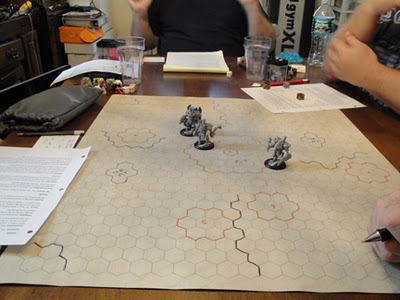
This week we were back to four players again, allowing me to see if ‘Naut Fight! remains playable with even more ‘Nauts battling it out in the arena. Not only do the rules still allow for fast and exciting play with more players, the game seems to increase in fun at an exponential rate! The only drawback was I had to supplement my playing pieces with a Binary Load Lifter from WotC’s Star Wars Miniatures line


Everyone except last week’s winner chose to create new ‘Nauts this time and we had a wider array of engines and specials. Our first-time player allotted most of his build dice into Speed, allowing him to run rings around the other three combatants. Seeing that it would take their combined efforts to bottle up and destroy the swift-moving construct, the rest of the gladiators put aside their differences for several rounds and turned their attentions on the poorly armed and armored ‘Naut.


Having learned that putting a big hill for the ‘Nauts to fight over in the middle of the arena keeps the battle in one place, I decided to mix things up this time around. Instead of a pile in the middle of the board there was a pit with a single hex platform at its center. A glowing orb floated above the platform, and the returning players recognized this as a body reinforcement globe that added to their ‘Nauts’ hit capacity. One player headed straight for it in the initial round, almost reaching it, before discovering that the orb jaunted around the arena randomly, coming to rest in the middle of areas of intermittent fire. This proved to be no obstacle for one ‘Naut who possessed an engine that help resist fire damage. He scooped it up early in the fight, but the flame rings around the arena continued to be obstacles throughout the fight.


There was still a lack of body slams or overbearing attacks in the match, despite my reminding the players of that option. We almost had an attempt to push one ‘Naut into the center pit, but the opposing gladiator lacked the movement that round to close and make the attack and the threatened ‘Naut moved clear in the following round.


The special weapon of the game was undoubtedly the Fimbul Gun, a cold-emitting cannon that could inflict freezing damage on a ‘Naut or be used to ice down hexes in the arena to create slippery terrain that slowed down movement through them. Two gladiators had these, and you can see the iced-down ground in the pictures (the hexes marked with blue lines). The Fimbul Guns helped corral the speedy ‘Naut into a corner where it was finally destroyed.


The game is turning out to be a surprise hit and the guys are beginning to hint that I should be working on a demonstration model to shop around. They continue to provide valuable feedback and suggestions, but the real proof of the game will come the next time I get together with my friendly, non-roleplaying board gaming group. If ‘Naut Fight! proves to be a hit with them, it demonstrates that this could be something more than another portion of the October Country. I may have to pick up two more ‘Naut miniatures to bring the possible number of players up to six. If six is still fast, furious fun, I might really be on to something here.


After ‘Naut Fight! wrapped up, we managed to squeeze in some actual October Country roleplaying. The party picked up a fourth member at Hunger Rock College and got a lead through some useful inquiries (and thus skipped a part of the adventure, but this is a good thing) that led them out to the burned-out insane asylum downriver from the City of Midnight. Hired goons were encountered and defeated, and the party now believes a group called “The Silence” is involved with the attempt to shut down the library. Sounds of chanting were heard and exotic incense filled the air as they entered the asylum, but what awaits them at the end of the soot-covered hallway will be revealed next week (along with some pictures and game stats).

Tuesday, January 31, 2012

'Naut Fight! Playtest 1

The consolidation process continues. The purpose of my last post was to lay the groundwork for this post and the following one, both of which concern playtesting a new skirmish miniatures/board game I've developed based on the October Country setting. 'Naut Fight! has become a popular diversion with this group and I suspect I'll be running another playtest of it again in the next two weeks. I've had non-roleplayers express interest in giving it a go, which I interpret as a good sign that I might be on to something here.

Yesterday saw the first official playtest of the October Country stuff and I was extremely pleased with the way things turned out. My gaming group is going through a transitive period, but is reorganizing to better address what everyone wants to play/run. I’ve finally put Labyrinth Lord behind me for awhile, and although I will return again one day soon, it was nice to explore other options and systems.

 We started off with a playtest of my steampunk automaton gladiator game, ‘Naut Fight! Although intended for one-on-one bouts, the rules are flexible enough to allow multiple ‘Nauts the opportunity to square off. And square off they did as three hulking brutes powered by experimental engines took to the area to battle it out for dominance. A little pre-match skullduggery didn’t turn out too well for one player when his pit crew spy was caught sneaking a peek in an opponent’s ‘Naut depot, but the trio was pretty much evenly matched at the start of the bout.


I sketched out the arena while the guys were building their ‘Nauts, using whatever popped into my head. A few walls, a pair of tar pits, a big old pile to play “King of the Hill” on, and a pair of special “You don’t know what happens when you enter these areas until you do so” spaces filled out the battleground. The ‘Nauts headed for the high ground early and most of the fight took place around the hill as everyone sought to use the top of the heap for combat advantage.


Speed was definitely the red-headed stepchild of traits as only one person decided to allocate more than a single die into that aspect of their gladiator machines. That could have been a bad move for one fighter when he fell into a pit and needed to roll above a certain number to escape. I’m wondering if this choice of allocation will remain true in future matches.


There was one attempt at an alliance to take out a less damaged ‘Naut about halfway through the fight, but it was rebuffed. Had it been accepted, we might have had a different winner. Instead, the two ‘Nauts with the least health beat the snot out one another for a bit while the souped up ‘Naut watched with glee.


The playtest revealed that I need to tighten up the language in my Specials descriptions and that I should make a cheat sheet with some of the other options available besides just blasting away with ranged weapons or slugging it out. That also could have changed things as ‘Nauts tried to clothesline one another or slam an opponent into one of the tar pits.


The guys had some good suggestions for future Specials to be added to the list of options: 360° Sensors that make it impossible for an opponent to gain a tactical advantage when attacking from behind and a Self-Destruct Feature that causes an area of effect blast when your ‘Naut goes down. I originally wrote the first rules draft with two fighters in mind, but after the three-man fight, I can see where those options would make play interesting when fielding teams or with multiple players. The match lasted about an hour and fifteen minutes, which, with three players, is a good sign that the game is short enough to be used in conjunction with the roleplaying game if needed, but also a fun diversion when you can’t get enough players for an RPG but need some entertainment on a rainy afternoon.

After the match, we took the October Country roleplaying game out for a drive. Three would-be heroes traveled to the City of Midnight to make a name for themselves. The group consisted of a budding magician who was an agent of the Juggler; a ballisturgist gun-slinger and agent of the Unnamed; and a great sword-wielding agent of the Red Ruin of War. They quickly found themselves hired by a librarian whose business was overrun by bibliophages. The trio went in, took names (thanks to an ungodly number of critical hits), and discovered that somebody is trying to drive the librarian out of business before he could even get started. The band is headed off to Hunger Rock College to collect a bounty on the slain bibliophages, but it’s obvious that there’s treachery afoot.

Running GORE was a snap, although I need to run through the rules again and make some adjustments and corrections (a blackjack can’t do 1d8 damage unless that’s subdual damage and I’m overlooking the rules for that). The benchmark skills are working as intended and so far they are allowing the PCs to do “cool stuff” early without overpowering the system or making combat a cake walk. We’ll see if this trend continues as the game progresses.

From the October Country: 'Naut Fights

One of the many purposes of the October Country setting is to give me a world where I can put all the genres and stories I want to experiment with in one place. It’s really a microcosm (or perhaps it’s a macrocosm) of my interests on display for all to see. When the setting is complete, the players and referees will find a wide variety of people, places, and things to power their adventures—many of which are very far removed from traditional fantasy.

As much as I pretend to be aloof from it, I am susceptible to popular culture and the current climate of entertainment. That includes advertizing, movies, and other popular trends. Lately, I’ve been seeing a hell of a lot of commercials for the movie Real Steel, a film where Wolverine builds a boxing robot and uses it to bond with his son. And while I’m not a big fan of machine-on-machine violence, the idea of gladiatorial matches between constructed warriors does tickle my fancy a bit. So I decided to add it to the October Country. I already had a region where it would be a natural fit, so why not? Even better, this made me to think about how I’d implement it in the campaign. That led to the creation of a mini-game that I’m currently working on. If I’m lucky, I might test the basic rules after my weekly game session on Sunday. But, without further ado, here’s a brief guide to ‘Naut Fights in the October Country.

High in the northern mountains, where stands of firs and lightning-struck pines grow thick on the granite peaks, is the legendary domain of the Lightning Lords. Secretive sorcerers of technology, the Lightning Lords tap the elemental forces of nature to birth miraculous constructions and machines rarely seen outside of their savagely beautiful country.

This devotion to their science comes at a cost: very few have the luxury of stepping away from their laboratories to attend to mundane matters. This lack of attention extends from simple matters such as hygiene to more complex concerns like the security of their borders. But, as men of science, the Lightning Lords long ago created a means to deal with certain pressing matters by means of mechanical proxies. No greater example of this exists that the famous ‘Naut Fights of the Lightning Lands.

Whenever two or more of the Lords come into conflict, be it over borders, resources, or the shared network of wires that channels lighting down from the heavens and throughout the nation, disputes are settled not on the battlefield, but in the arena. Each Lord activates one of his stable of Juggernauts (commonly called simply ‘Nauts) and the combatants battle it out in a formal duels attended by the Lords’ servants and seneschals. The Lord whose champion wins the bout has his way in the matter under dispute and the disagreement is put to rest. It is extremely rare for the losing party or parties to dispute this—partly because of tradition, but mostly because they lack the time to submit a formal protest to the informal council that arbitrates the myriad baronies that comprise the Lightning Lands.

These duels are seldom to destruction—the cost to build and maintain a stable of ‘Nauts is high and the strange susceptibility to deterioration that technology in the October Lands already deals with is enough to convince a losing ‘Naut’s master to throw in the towel. The battered ‘Nauts are pulled from the arena to be repaired by the Lightning Lords’ crews of Gearheads, those uncanny argents of the Clockwork Man who keep technology functioning beyond the Pale.

A ‘Naut is a wonder to behold. Standing near 10’ tall, these machines are typically humanoid in appearance and operate on steam, phlogiston, zeusiam, or clockwork engines. Two or more weapons are affixed to each ‘Naut, and close combat is preferred over ranged armaments. Each champion is armored, but the level of protection varies from model to model. Some Lords prefer Hulk Class bruisers or Behemoth bashers, while others prefer Springheel skirmishers or Dancer Class athletes. No matter what style meet in combat, one never forgets their first ‘Naut Fight.

What makes these battles so memorable is the skill of the combatants. ‘Nauts do not fight like constructed warriors, animated by gears and fire, but like living fighters that think, strategize, and react much faster and more skillful than a machine ever could. The secret to this is that each ‘Naut is operated by a literal “ghost in the machine.” When crafted, the spirit of a dead creature is attuned to a ‘Naut, allowing the soul of that individual to possess the machine and operate it as if it were its own living body. The ghostly fighters serve their masters for a variety of reasons and are usually well-treated by their individual Lords. Some ghosts have served their Lord’s family line for centuries, becoming legends in their own right and feared by all challengers when met in the arena.

When visiting the Lightning Lands, be it to hire the services of a Gearhead or to book passage on one of the realm’s electrical barges or dirigibles, be sure to attended a ‘Naut Fight. Exhibition matches are commonly held for bragging rights and entertainment, and it is rare for a week to pass without at least one bout occurring in a barony.

Tuesday, January 24, 2012

From the October Country: Writhing Madness

Another refugee from Secret Antiquities. Although I don't play the skirmish miniatures game Malifaux, I've become quite enamored of some of the castings. The sculptors and I seem to share a common mindset and a lot of the Malifaux line fits in quite nicely with the October Country. When I saw this one, I knew it needed a place in that odd world. The entire mini is coated in transparent Day-Glo paint and emits an eerie phosphorescence under a blacklight.

Sunday's game saw the PCs going toe-to-toe with members of a group called "The Silence." Led by a manimage, a sorcerer whose spells deal with madness, the Silence was in the midst of conjuring up a madness "elemental" from the spirits of the dead inmates at the Crow Tree Asylum when the party showed up. Things did not go well. I take a lion's share of the blame for that, as the encounter I designed was more formidable than intended. I'll fix things next play session. In the meanwhile, here's yet another unusual occupant of the October Country.

Writhing Madness

STR: --
CON: --
SIZ: --
DEX: --
INT: 3d6 (10-11)
POW: 4d6 (14)
CHA: 3d6 (10-11)

Move: 8
Average HP: 14
Armor: Immune to non-magic attacks

Attack: Bite--60% Damage: 1d6+d2+ madness (POW vs. POW or succumb to temporary madness)
Other Skills:  Dodge: 40%

Conjuring Cost (as per rules on pp. 35-36 of the GORE rule book): 20 MP

Summon Writhing Madness
MP Cost: 1+
POW Cost: 0
Range: 20’

This spell summons forth a swirling maelstrom of madness from the Nightmare Lands and impels it to do the magician’s bidding. The spell must be cast in an area where madness was once common, such as asylums, hospitals, slums, or other locations of the referee’s choosing. The total MP cost of the spell is dependent on the size and power of the entity summoned as per the rules on p.36

Tuesday, January 17, 2012

From the October Country: Architurgy

The old house had stood near the crossroad since the Uld Dominion still controlled these lands. Now a rotting shell, its roof sagging like the broken back of a dead cat and obscured beneath a shroud of brown ivy, the building warned away all who approached with threats of imminent collapse and possible haunts.

The Hard Case Krewe arrived just as the moon rose, making their way through the once-fine front door and gingerly stepping over the shattered glass that littered the foyer. In the rotting sitting room, the youngest of the krewe moved to a mildewed divan and took a seat. Brushing a wayward strand of auburn hair away from her ear, she closed her eyes and listened. The rest of the group, arm, alert, and nervous, peered intently into the shadows around them.

High above them, the wind blew through the holes in the roof and pushed gently against the eaves. Ancient beams groaned softly and warped, water-damaged floorboards moaned as the decrepit house shifted in the breeze. The wind died abruptly and the young girl opened her eyes.

“The gold we seek is hidden beneath the floor of the nursery, but there is a spotted carnithing lurking in the attic that needs be dealt with first,” she said, staring up at the peeling ceiling overhead. Standing, she rejoined her comrades who were already drawing their blades and pistols and moving towards the creaking stairs that lead to the ruin’s upper floors…

Architurgy (base 0%) is a rare talent found both on Earth and in the October Country. Scholars of esoterica debate whether it is a true psychic ability or a form of minor, innate magic produced spontaneously by a gifted, yet untrained few. Whatever the case, architurgy (sometimes called domuscopy or “speaking the architongue”) is a potent if limited form of divination.

The successful use of architurgy allows the possessor of the talent to understand the “language” of old buildings. What sounds like the groaning of beams, the creaking of hinges, and the general noise of an old home settling is actually a secret language spoken only by buildings with long and often eventful histories. Using the talent requires a few moments (1d10 minutes typically) of quiet sitting and listening. If the environment is too loud and drowns out the building’s ambient noise, the talent cannot be used and the architurge must wait until quiet once again pervades the structure.

If conditions allow the use of the talent, the architurge focuses his or her mind on a question they wished answered or a condition regarding the house they’d like to know. When successful, they deduce the answer to their inquiry by the noises of the house. The clarity and detail of each answer depends on the age of the building: the older the house, the more detail it tends to provide. Unfortunately, with this detail comes greater difficulty in understanding what the building is saying. Most old buildings suffer from “emotional static”—emotions and psychic residue created by highly charged events that occurred within the building during its history. Breaking through that static is difficult, but if the architurge can do so, she can learn a lot about the building in which she stands. Architurgy cannot be used on a building less than 50 years old and suffers a -5% penalty for every 10 years past 100 that the structure has been standing.

Using the architurgy talent requires the expenditure of 1 MP for each condition or question the architurge wants to know about. An architurge can make a number of inquiries equal to half her CHA score, but must make a successful skill roll and spend a MP for each one. A failed roll indicates that she can coax no more information from the building and cannot attempt to learn more with the talent until she has advanced in its skill.