Showing posts with label magic items. Show all posts

Thursday, May 5, 2011

Cauldron Spirits

Some magic-users eschew the traditional familiars and homunculi for another form of servant: the cauldron spirit. These beings are traditionally recruited from the ranks of the recently-deceased and bound within the mage’s primary cauldron, crucible, forge, or alembic. A cauldron spirit is part-magical item, part-living creature, and can only be created by magic-users or elves of name level or higher.

The creation of a cauldron spirit begins with the mage making contact with a dead soul. Usually this is accomplished with the assistance of the clerical spell, speak with dead, but negotiations with cognitive ghosts is another possibility. The soul to be used in the creation of a cauldron spirit must be willing to serve the mage, and will likely barter for a limited duration of service or some reward that might be of use to the spirit (assistance to living relatives, providing resurrection for the spirit after service, destruction of a hated enemy, etc.). Truly desperate or evil magic-users have employed trap the soul to gain the spirit they need.

Once an arrangement with the spirit has been made, the magic-user performs a ceremony to bind the spirit with its focus object. This rite takes 1d4 hours to complete and costs 5,000 gp in materials. Any interruption before the ceremony’s completion negates both the rite and the components involved, requiring the magic-user to start from scratch.

Each cauldron spirit has a loyalty score as determined by the spell-caster’s Charisma. This score can rise or fall depending on how the magic-user treats his spirit or abides by the agreement struck with the ghost prior to its employment. Any command the magic-user gives the spirit which goes against its nature requires a successful loyalty check for the spirit to comply and assist its master. A cauldron spirit who refuses to comply with its master’s command may be forced to follow directions. In order to compel the spirit to abide by its master’s orders, the magic-user must spend two complete rounds forcing its will upon the spirit. The cauldron spirit must then make a save vs. spells or concede to the spell-caster’s wishes. Each time a magic-user successfully compels the spirit to obey reduces the ghost’s loyalty score by one point.

The physical destruction of a cauldron spirit’s focus item or a successful dispel magic cast against the same releases the spirit from its bonds and negates the item’s ability to house another such ghost. For this reason, most magic-users keep their cauldron spirits safe at home. The creator of a cauldron spirit can free its ghost at any time by conducting an hour-long rite that employs 500 gp worth of materials.

The benefits of having a cauldron spirit are threefold. Firstly, all spell-casting times (if used) are reduced by half. Secondly, the cost of creating magic items and researching spells are reduced by 25% as is the time required to create them. Thirdly, a cauldron spirit can “store” spells as if it were a magic-user equal to half its master’s level rounded down. These spells are typically utilitarian (detect magic, read magic, dispel magic, etc.), but some spellcasters trust their cauldron spirits enough to allow them to hold offensive magics in case their laboratories should come under attack. These spells are cast as if by the magic-user, himself. There are no innate restrictions keeping a cauldron spirit from turning its stored magic upon its master, however, and magic-users are advised to keep this in mind before gifting their magical servants with powerful, destructive spells.

Sunday, March 27, 2011

Dragontales: “Out of the Eons”

The third story in the Dragontales anthology is by an author that will produce a response of either “Him?” or “Who?” depending on the reader’s familiarity with the Golden Age of Comics. “Out of the Eons,” the tale that concerns us today, was written by Gardner F. Fox, the man responsible for (in whole or in part) such comic book superheroes as the original Sandman, Flash, Hawkman, Doctor Fate, and the Justice Society of America. He also wrote the first Batman stories not penned by creators Bob Kane & Bill Finger, introducing some of the concepts and equipment now firmly embedded in the Batman mythos. In addition to his work in the comic industry, Fox penned numerous novels in almost every imaginable genre; sword & sorcery fans may best remember his creations Kothar, Barbarian Swordsman and Kyrik: Warlock Warrior, both of whom are listed in the famed Appendix N as inspirational reading. According to one source, Kothar’s first story, “The Sword and the Sorcerer” is responsible for the lich as we know it in D&D.

Neither Kothar nor Kyrik is the subject of “Out of the Eons.” Instead, the tale concerns another of Fox’s sword & sorcery heroes: Niall of the Far Travels. Niall may have the honor of being one of the few, if not only, fantasy heroes who owes his entire existence to Dragon magazine. Niall’s first appearance was in Dragon #2 in the story “Shadow of a Demon.” The hero would reappear several times in the pages of Dragon, returning in issues #5, #13, #23, #33, #36, #38, #44, and finally #55. “Out of the Eons” is located chronologically between the tales “The Cup of Death” from #38 and “The Lure of the Golden Godling” in issue #44. In the interest of full disclosure, “Out of the Eons” is the only Niall of the Far Travels’ tale I’ve read despite owning the first 250 issues of Dragon on CD-ROM.

“Out of the Eons” begins in an unpretentious manner: Niall, Commander General of the armies of Lurlry Manakor, king of Urgrik, is expanding his wine cellar. When his pick unearths a wall that simply shouldn’t be there, however, Niall inadvertently unleashes an ancient evil upon the world; a creature that escapes from “Out of the Eons.”

Almost immediately thereafter the reader becomes aware that Niall shares a special relationship with the goddess Emalkartha and her human avatar, Lylthia. The relationship is of an amorous nature and this becomes an issue throughout the tale. Thanks to Niall’s connection with the divine, he learns that what he unleashed was a being known as Adonair who once threatened the world—you guessed it—eons ago before being imprisoned by the gods. So long ago did the deities challenge Adonair that they not only forgot he was buried next to Niall’s every-expanding wine cellar, but they can't quite remember how they defeated him the first time around. To compound matters, Adonair, who appears as a green fire, decides he needs a physical body to conquer the world and deems Niall a suitable host.

The rest of the tale involves Niall’s quest to locate something the gods hope will defeat Adonair and their attempts to shield him from being possessed. As a protective measure, Niall is accompanied by the goddess Thallatta, which leads to problems on the home front when Niall starts “paying homage” to anther member of the pantheon, so to speak. Conan never had issues of this magnitude.

Speaking of the Cimmerian, “Out of the Eons” reminds me very much of a “King Conan” tale. Niall is not a wandering reaver, but a warrior of much renown and political status, and his duties to King Lurlry and his queen is what motivates him through much of the story—that and getting back into the good graces of Emalkartha.

“Out of the Eons” is pulp sword & sorcery, the first example of the genre we’ve encountered in Dragontales. Fox was exposed to the writing of Edgar Rice Burroughs at an early age and the impact that Burroughs had on Fox’s development seems to linger long after exposure. Niall is very evocative of John Carter, both in his being a warrior of skill in a position of great influence and his romantic relationship with a powerful, beautiful, and ultimately alien creature.

Having not been exposed to the Niall tales preceding this one, I was ultimately left to judge it solely on its own merits. As a whole, the tale is entertaining, but not remarkable; a story suitable to while away a quiet night or an afternoon at the beach. When I first read it, so many years ago, I do remember being more fond of it, but for a reason having little to do with the plot of the tale.

“Out of the Eons” can be read as a good example of the D&D endgame, the time when the PCs put down their swords and start dealing with issues that can’t be solved solely by riding out and smiting them with sharp objects…even if that’s what Niall eventually does. This tale introduced me to a sword & sorcery hero who was not a landless wanderer, and the events of the story laid the groundwork for how my friends and I did “name level” play. Our high level PCs often got involved with world-shaking events and hobnobbing with the gods, even as we dealt with the mundane concerns of building a new tower on our holdings or excavating a new wing in our thieves’ den. Looking back, I now know that “Out of the Eons” was responsible for this approach to dealing with high level play. I really should go and read the early Niall’s tales and see how he grows into his position. They may give me new insights on the D&D endgame that may be of use in my current Labyrinth Lord campaign.

I also love the beginning of the tale and how the event that launches the plot is so mundane. Digging a new wine cellar is about as incongruous a starting point for a tale involving alien powers and gods as you could imagine. It strikes me as just the sort of minor activity that would get Fafhrd and the Mouser embroiled in some wild scheme. This kind of dichotomy tickles my fancy and the story wins me over because of it.

Before I get to the game material, I should note that “Out of the Eons” is illustrated by Kevin Siembieda. Siembieda is one of those designers that I forget can produce art as well as write, much like Paul Jaquays. I always remember Siembieda more for his Palladium work and the occasional explosion that occurs over there than I do for his art, and every time I see his name scrawled beneath a piece of illustration, I always have that “Oh yeah…” moment. In rereading this story and encountering his work again, I must admit that I kept expecting to turn the page and confront some skull-motif, jackbooted Nazi thug laying in wait for me. The Rifts RPG has apparently done a number on my Siembieda art expectations.

Elixir of Desperate Measures
Many millennia ago, when the universe was a newborn dream, the gods gathered in their starry hall to address a lingering concern. As powerful as the gods were, the cosmos was a mutable place and there might come a day when one of their number became too powerful to be held in check by his fellow deities. Should that day ever come to pass, the cosmos would be at the mercy of that deity alone.

One of the wisest of Powers suggested that the gods pool their divine essences to create a substance that could slay a single god outright and that they thereafter secret this elixir upon the earth in a place impossible for any but a great hero to reach. If the day ever arose that one god needed to be put down, the location of the elixir would be revealed to a mortal hero and it would become their task to destroy that which the gods themselves could no longer challenge. The result was what the bards sing of as the Elixir of Desperate Measures.

When found, the Elixir appears as a glowing white liquid held in a silver cup of plain design. When a weapon is touched to the elixir, it spreads across the length of the weapon, running like water, but clinging like pitch. Once the weapon’s edge is completely coated by the Elixir, the liquid glows brightly for a moment, then fades away as if the weapon absorbed it completely, leaving no trace of the Elixir behind.

The Elixir’s power effectively turns the implement into a weapon of god-slaying. The weapon acts as an arrow of slaying against deities. Its enchantment is only good for one or two successful strikes against a god and it attacks as if a +5 weapon. Each time a deity is struck by the weapon, it must make a saving throw versus death as if it were a 1st level fighter. Failing this save results in instantaneous and irrevocable death. A successful save means the deity suffers damage as normal, provided that is possible given the weapon, attacker, and any other defenses the god might enjoy.

Suffice to say, the Elixir is nearly impossible to locate and it is protected by many magical and monstrous safeguards. No single god knows the location of the Elixir and only several working in concert can deduce the location of the substance and convey its hiding place to a mortal hero. They would only do so in the extremely unlikely event that one of their number amasses enough power to threaten the universe and is deemed a danger to the existence of all living and non-living creations in the cosmos.

Monday, March 7, 2011

Dragontales: “The Wizards Are Dying”

The first story in Dragontales is “The Wizards Are Dying” by John L. Jenkins and illustrated by James Holloway. The story tells of an adventuring group brought together by chance who embark on a quest to defeat a lich that is killing the practitioners of magic. Running thirteen pages in length, it is the second-longest story in the anthology.

A casual search of the web fails to turn up more works of fiction by John L. Jenkins, and Dragontales is his sole gaming-related credit according to the Acaceum, making it likely that Mr. Jenkins was a hobbyist gamer who could turn a phrase well enough to catch the eye of editor Kim Mohan and not a professional author or game designer. Whatever the case, the story does demonstrate that Jenkins had both decent writing chops and an understanding of D&D.

“The Wizards Are Dying” is unabashedly game fiction. Nowadays, in the wake of the glut created by TSR, WotC, and every other game publisher with a brand to sell, game fiction is treacherous ground. Some folks love it; others despise it, but there’s no escaping it. Back in 1980, however, game fiction was the exception rather than the rule. Outside of the pages of Dragon magazine and other professional or amateur gaming periodicals, there wasn’t much of a market for the stuff. Andre Norton had started the ball rolling with Quag Keep back in 1978, but it would be another six years before the TSR game fiction machine churned out the first official D&D fantasy novel.

With that thought in mind, you might be better equipped to understand just how mind-blowing “The Wizards Are Dying” was to my young mind. I was reading a story that used all the elements of D&D that I had come to know over the last year in action. It was like experiencing an adventure come to life in a much more vivid form than the “Example of Play” from the Basic rulebook and the DMG could produce. There was a cleric that healed wounds, a dwarf with an enchanted axe, an elven wizard who threw fireballs, and a bevy of liches, trolls, and even manticores to do battle with. I was in roleplaying rapture!

At the time, “The Wizards Are Dying” was one of my top three favorite stories in the anthology. Now, however, it has slipped a bit in ranking, mostly from my having read better examples of gaming fiction. But this is the fault of the reader, not the writer, and I’m still impressed with the job Jenkins does considering there weren’t many examples of this type of story to draw upon back in 1980. And although the story itself may have lost a little luster over the years, in rereading it I still see the influence that it had upon me and how it shaped my preferences for both gaming and fantasy fiction.

The first half of the story involves assembling the party and getting them apprised of the situation they face. Because of this, we see a lot of what we gamers would call “party downtime”: the adventurers stop for a meal in an inn (where the party naturally forms); they lounge in the inn room and discuss the task ahead; they go seeking a scholar to help them learn of what they face; even the journey to the adventuring site via caravan is covered. I’m probably in the minority, but I always find these parts of a fantasy yarn especially interesting. It is during these quiet moments that we learn the most about our protagonists, and when especially well-written, I often consider them to be superior scenes to the fire and thunder action that occurs later on. For example, my favorite scenes in “Ill Met in Lankhmar” are those which occur after the robbery that brings Fafhrd and Mouser together: the walk back to Mouser’s abode and the meeting and revel that the foursome share upon arrival. These quiet moments, filled with the mundane details of life, shine all the brighter when compared to the foreign extravagances that happen once the plot begins it unfold in earnest. Looking back on the “Wizards Are Dying,” it is entirely possible that this tale helped shaped this love of mine.

As for its influence on gaming and campaign building, the story added a few things to my repertoire. Jenkins sets the tale against a standard fantasy backdrop (and one can only wonder if it was based on his home campaign), but there are a some interesting nuances that may have crept into my developing design proclivities. The Crystal Hills, a place where much of the last half of the tale occurs, may have influenced the encounter with Song of Night Screams in Stonehell Dungeon for example. And it remains an evocative enough locale that I had to make certain it wasn’t something lifted from the World of Greyhawk, making it a creation of Gary Gygax.

One cannot talk about the story without mentioning the illustrations that accompany it. “The Wizards Are Dying” features several pieces by TSR artist and illustration workhorse, Jim Holloway. I’m uncertain of when Holloway got his start with TSR, but I must assume that he was at the start of his career when he did these. This is not to say that they are poorly rendered; anyone familiar with Mr. Holloway’s work will recognize his style immediately upon glimpsing them. The pieces do have a certain “roughness” that is absent in his later work, though, and those who usually claim to find Holloway’s work “ too cartoonish” may find these rawer pieces more to their liking. The only quibble I have with them is that the gnome featured in the tale is depicted as a halfling, but that may simply be a miscommunication between writer, editor, artist, or all three.

“The Wizards Are Dying” is not going to win any awards for writing, but it does accomplish what one supposes it intended to: Tell an entertaining tale firmly grounded in the D&D setting. It provides enough pleasure and comfortable diversion that forgiving its flaws is easy enough. Those whose roots are older and run back deeper into the hobby’s past will undoubtedly get more enjoyment from the story than those who grew up on the more recent products of the game fiction machine.

As now, as promised, something inspired or stolen from "The Wizards Are Dying” for your own fantasy campaign:

Faendril’s Fireproof Cloak: This red but otherwise nondescript article of clothing possesses two abilities. First, it is immune to damage from normal flames and provides the wearer with a +1 bonus to all saves vs. magical fire. Secondly, it has the power to cloak a flame source from sight, effectively “turning off” the fire for a time. To do this, the cloak must be placed over or in front of the fire source. A campfire with the cloak draped over it would cease to produce light as would a torch placed within the folds of the garment, making it perfect for the adventurer who needs to hide his light source without permanently extinguishing it. So long as the flame source is covered in this manner, it produces no visible light or heat, but continues to burn fuel at its normal rate.

(For those of you who need them)
Experience Point Value: 500
Gold Piece Value: 3,000

Monday, January 31, 2011

In Which Misreading Leads to Creativity

I was reading the paper this morning and quickly glanced over a headline that read “Steep Gun Laws Considered.” In my haste, I read “Sleep Gun Laws” and thus the following was born. Use it in your next weird science fantasy campaign or have it left over from the Elder Race that founded the campaign world.

Sleep Gun: Formed from an unearthly substance similar to glass, yet stronger than adamant, this object is of a fluted, Baroque design. The device features a protruding grip by which to hold it while aiming the object’s tulip-shaped barrel towards an opponent. When operated, the item fires an invisible, soundless beam of slumber-inducing particles, causing the victim to fall into a deep sleep. This beam acts like the 1st level magic-user spell, sleep, but only affects a single individual of up to 4+1 HD. Although the victim does not receive a saving throw to avoid the effects of the beam, the sleep gun must successfully strike its target and requires a successful “to hit” roll on the part of the operator. The sleep gun ignores armor for the purpose of determining a successful strike, but DEX adjustments apply to both the operator’s attack roll and to the defender’s adjusted AC. Sleep guns have 2d10 power charges when found.

Friday, January 14, 2011

Krang the Steel God & Quintessential Items

Steel screams when it's forged, it gasps when it's quenched. It creaks when it goes under load. Steel is alive, son.

Krang the Steel God, sometimes known as Krang of the Hammer or the Ever-Smith, is a minor demi-power, but an important one. Krang rules over the tensile strength of steel, the durability of iron, and the ability for those metals to hold an edge. Smiths and soldiers are his usual devotees, but many who rely on metal for their trade or survival will speak a brief prayer to Krang before using an item under his influence. Krang’s holy symbol is a piece of razor sharp steel or iron etched with unusual symbols that spell out the deity’s name in Smithik, the secret trade language of smiths. Krang is aligned with Wonder in the Old Pantheon.

Although Krang has no true priests (spell-casting ones that is), he does possesses a small group of fanatical smiths who are able to invoke the god’s power when crafting an item. This group is known as the Ferrumic. Each Ferrumic smith is a migrant crafter, travelling from settlement to settlement to trade, teach, and, most importantly, search for veins of hematite especially blessed by Krang, for it is these special strains of ore that they need to create the quintessential weapons and armor they are known for.

Quintessential Objects

Ferrumic smiths can create objects using the rare forms of iron ore infused with Krang’s essence. These items are known as quintessential pieces, being superior to even masterwork items. Each has a minor magical effect of limited duration, but is not a true magical item such as one enchanted by magic-users and elves. As such, quintessential objects cannot usually strike creatures only affected by magic item (but see below).

Quintessential objects enjoy the benefits of masterwork items (+1 to attack OR damage rolls in the case of weapons; movement rate improved by one step for armor). Additionally, there is a chance that a quintessential object gains a random magical ability during its creation process. This base chance is 20%. However, the smith can attempt to improve the chance of attracting Krang’s attentions to the crafting process by using rare or exotic substances during the item’s forging. Such materials are expensive and they require an additional expense on the part of either the smith or the one who commissioned the piece. For each additional 100 gp spent, the chance for the weapon developing a spontaneous quality is increased by 10%. The probability may never be increased above 80%, however, and the money is spent regardless of whether the object develops special qualities or not.

Krang is an enigmatic god and even the Ferrumic cannot predict what qualities he might bestow upon their work. If the check reveals that the object is imbued with a special quality, the referee should roll on the table below to determine what power the item possess. Note that each of these abilities can be invoked only a finite number of times, and that, like a wand; each use reduces the number of “charges” the item contains. Each quintessential item has 2d10 uses when first crafted. After all those uses are gone, the item is treated like a regular masterwork item. The object’s owner can attempt to have a Ferrumic smith re-consecrate the item, but such a service costs a flat 500 gp and has only a 50% chance of success. If this attempt fails, the item’s power can never be restored. If it successful, it regains 1d10+5 charges. A quintessential weapon can only be re-consecrated one time.

01-03: Item can throw magic missiles as if it were a 5th level magic-user (3 missiles per use)
04-06: Item unlocks a single, non-magical lock within 5’.
07-10: Item causes any single attack against the owner to be rerolled.
11-13: Item allows the owner to levitate for 1 round per use expended. Movement rate is 20’ per round.
14-17: Item allows the owner to reroll any failed check against fear. This is a reflexive power and requires no action on the part of the owner.
18-21: Item produces a small flame (candle-sized) up to 30’ away.
22-25: Item allows the owner to affect creatures normally only struck by magical weapons. This effect lasts for 1d4+1 rounds.
26-28: Item produces a shocking grasp effect when striking/struck by an opponent, doing d8+1 damage.
29-33: Item allows the owner to ignore the effects of a web spell or giant spider webs.
34-37: Item turns undead as a 2nd level cleric
38-41: Item detects poison within 15’ radius.
42-46: Item can produce light as the clerical spell (12 turn duration)
47-50: Item reduces any fire-based damage taken by half. If the damage allows for a saving throw and it is successful, only one-quarter damage (rounded down) is suffered.
51-53: Item has a 4 in 6 chance of detecting secret doors within 15’ radius.
54-57: Item negates the effects of a sleep spell on the owner only. This is a reflexive power and requires no action on the part of the owner. The owner is still included in the # of HD affected.
58-62: Item resists the effects of corrosive attacks from creatures such as rust monsters, green slime, grey ooze, etc. This is a reflexive power and requires no action on the part of the owner.
61-64: Item cloaks the owner in gloom, increasing his ability to surprise opponents to 3 in 6. The created shadows only affects owner and the surprise chance is cancelled if accompanied by others.
65-68: Item grants the owner a +1 bonus to any single saving throw.
69-73: Item creates water as a 1st level cleric.
74-76: Item allows the owner to blink for 3 rounds.
77-81: Item grants the owner infravision for 2d6 turns.
81-83: Item creates an arcane eye which lasts for 1 turn.
84-87: Item deflects non-magical missile attacks with a successful save vs. breath attacks.
88-91: Item grants the owner a boost of speed that allows him to automatically wins initiative for the next round. It has no other effect. The rest of the party must roll for initiative as normal.
92-95: Item allows the owner to read languages.
96-99: Item prevents the owner from losing his footing. This is a reflexive power and requires no action on the part of the owner.
00: Item becomes a true, permanent magical item of +1 power.

Cost of crafting a quintessential item

The base cost of materials and labor for a Ferrumic smith to create a quintessential item is the item’s normal cost plus 400 gold pieces. This allows for the base 20% chance of the item developing special powers. Additional funds may be spent to increase this percentage as noted above.

Crafting times

The time required to forge a quintessential item depends on its size and complexity. A quintessential weapon can be created in one week’s time. A quintessential shield requires 7+1d8 days to complete. It takes a full month to create a quintessential suit of armor.

Thursday, December 16, 2010

Visiting the Kinan-M’Nath

Into the whirlpool
Where matter vanishes
Degenerate star
Arm of Orion

An iron sun
The forbidden circle
Anti-matter is the
Black horizon

Blue Oyster Cult, “Heavy Metal: The Black and Silver

Now that visitors know what to expect once they arrive in the Uncertain Lands, how exactly do they get there? For this, we must turn to the sages of the ages, who, in their ink-spattered wisdom, have determined that there are four known methods of transportation between the Kinan-M’Nath and other worlds.

Method #1Spell Craft: Perhaps the easiest method of world travel, this method is restricted to those who have achieved mastery in magic, have discovered a magic item capable of cross-world travel, or can pay someone to provide these means of travel for them. In general, spell craft travel covers cross-world travel achieved by use of astral projection, gate, limited wish, plane shift, and/or wish, or through magic items such as an amulet of the planes, a cubic gate, or a well of many worlds. The benefit of this method is that the caster or item user has some control over where they arrive—provided they have some familiarity with the lands of the Kinan-M’Nath.

Method #2Realm Storms: Highly unpredictable, those arriving in the Kinan-M’Nath by way of a realm storm seldom do so willingly. These planar tempests tear the boundaries between worlds, although they appear to be nothing more than extremely strong thunderstorms to those caught in them. More than one party of adventurers has sought shelter in a cave during a realm storm only to emerge after it ended and find themselves in a completely different world. Some powerful mages and learned sages can predict where and when a realm storm may next appear, but finding such an individual and meeting their price is an adventure in its own right.

Method #3Etheric Mists: Like realm storms, etheric mists are a supernatural event. They are even more unpredictable than the storms, however, and some sages believe that etheric mists are examples of Fate in action. Appearing as a smoky gray fog, etheric mists are cold, thick, and damp, restricting sight to a mere 5’. Alien noises and weird echoes sound from the depths of the mist, and an occasional phantasmagorical shape can be barely discerned. Etheric mists appear without warning, even on the sunniest of days. They envelop travelers completely, last anywhere from several minutes to several hours, and, once they dissipate, leave the wanderers in a new land.

Image by Stefan Poag. Please visit Knucklebones.net for more of Stefan's wonderful work.

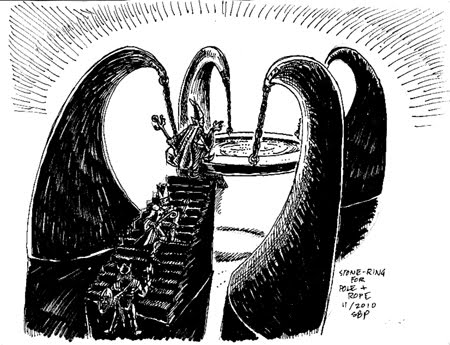
Method #4 – Hangways: These permanent gates were created in the dim past by unknown hands for indeterminable purposes. Appearing as 12’ diameter stone hoops, hangways are typically found suspended horizontally between four massive supports and dangling 10’-12’ above the ground. Usually a set of free-standing stairs or a ramp leads up to the edge of the hoop, allowing travelers easy access to the 8’ diameter opening in the hoop’s center. The air inside this aperture shimmers as if hot, although the temperature is the same as the surrounding atmosphere. Although hangways share the same general appearance of horizontal hoop hanging from supports, details vary from place to place and world to world.

Image by Talysman. Please visit Talysman's blog, The Nine and Thirty Kingdoms, for more.

Hangways, sometimes called “hopgates” due to their method of egress, allow free travel between worlds to specific locations. Unlike the less predictable methods listed above, hangways remain in fixed locations and provide access to a matched site on one or more alien worlds. Use of the hangway is a simple matter of hopping through the horizontal aperture and falling between worlds. The traveler lands unharmed on the floor underneath the other hangway’s matched hoop on a new world. Travel between world can only occur by stepping through the topside of the hangway’s hoop. Attempts to reenter a hangway from below are always unsuccessful.

Image by Talysman

While the majority of hangways are keyed to a single location, some allow access to multiple planes. Hangways with multiple connections are usually time-based, meaning that a single hopgate will connect to one place during a certain time of the day, week, month, or year, and connect to another at an alternate time. Sometimes manuals, instructions, carvings, etc. are found near these types of hangways, but this is not guaranteed. Adventurers intending to travel via hangways should research their chosen hopgate carefully before embarking on their journey.

Hangways are the most common planar gate found in the Kinan-M’Nath. At least two are known to exist within the boundaries of Stonehell Dungeon; others can be found in forgotten places (both indoors and out) across the Uncertain Lands. The most recent wayfarers to arrive through a functioning hopgate are the members of The Society of Planewalkers, currently operating out of Blackpool. These outsiders purportedly originated in the Lands of the Rotted Moon and have displayed talents and traits unusual to the Kinan-M’Nath. Whether they will become a force for the Weal or the Woe remains to be seen.

A Note About the Duration of Stay: Visitors to the Kinan-M’Nath should be aware that their method of travel to the Uncertain Lands may have an impact on how long they remain in that world. Etheric mists and realm storms are notorious for carrying a person or persons between worlds only to return them to their place of origin days, even hours, later. And while spell craft and hangways almost always allow for unlimited visitation, even these methods have been known to abruptly fail, resulting in the traveler’s sudden departure from this realm. In other words, the referee has full control over the length anyone visits his campaign, making it much easier for a guest PC to suddenly fade away and return to his own campaign world if needed at the end of a session.

A very, very heartfelt thanks to Stefan Poag and Talysman for taking the time to contribute their talents to an unconventional idea dreamed up by me on a whim. Your contributions are greatly appreciated!

Sunday, May 23, 2010

Eat Me, Drink Me

If you’ve had the opportunity to check out Stonehell Dungeon or anything else I’ve put out there in the recent past, you no doubt noticed that I enjoy conjuring up themes and then riffing off them in my adventures. Some of these themes are more concrete than others, but they almost always pervade the scenario or location, giving the adventure a central support upon which to hang ideas. It doesn’t matter to me whether the players pick up on these themes or not. Their presence serves to entertain me and help guide my design choices.

Yesterday, the party finally put the Temple of the Goat behind them (although the possibility always remains that they may one day return to deal with the chamber of ambulatory, character-smiting statues). Having done so, I can now reveal that the theme of that location was “mutation” in all its negative forms. From the bizarre toadhemoths to the fungal dead to the weird murals that decorated the site, the temple pointed to things not being as they should.

This theme led to thoughts of physically altering the characters as well, so I inserted two substances that could lead to strange mutations if sampled. My players did not let me down.

As an aside, Maggu Mani is a corruption of Magna Mater or “Great Mother”, a term that refers to the god/dess, Ishnigarrab, which was who the Temple of the Goat was dedicated too. Some of you may know Ishnigarrab by another name: Shub-Niggurath.

Fruit of the Maggu Mani: This strange life resembles gooey yellow-purple polyps the size of cantaloupes. They grow in grape-like clusters and are covered with a slick, sticky film. This material is a plant native to Nihil and was brought down by the Overpriest to serve his nutritional needs. The strange fruit can be either profoundly stimulating to the human body—or a nasty toxin. Anyone eating one of the polyps must make a CON check. If they succeed in the roll, their body shrugs off the alien matter, but they become horrible sick in the process (equal to the bite of a giant centipede). If the roll fails, however, the alien fruit causes their body to undergone a slight and visually unnoticeable change, resulting in the gain of 1 point of CON permanently. There are enough fruits here for ten (10) such meals. They rot quickly after being plucked (within 4 hours).

Milk of the Maggu Mani:This grey fluid is the milk of Ishnigarrab him/herself and produces strange effects on living tissue. Anyone who samples this liquid must make a save vs. poison. If successful, the drinker immediately gains the benefits of a full day’s food and heals 1d3 points of damage. If the save is failed, they undergo a spontaneous transformation. Roll on the table below:

1

1d4 sightless eyes grow on the drinker’s hands

2

A second mouth sprouts from the drinker’s throat. This mouth can only make whimpers and horrid smacking sounds.

3

Hair follicles secrete urine regularly

4

Drinker’s mouth fills with puss-containing blisters and boils. Drinker can breathe through nose but cannot eat or drink.

5

Wormlike tendrils sprout from the drinkers nostrils.

6

Drinker’s body absorbs a random body part – 1: left arm; 2: right arm; 3: left leg; 4: right leg; 5: reproductive organs; 6: head (this is fatal).


Roll each time the liquid is drunk, rerolling on duplicated results. If the character is afflicted by all six effects and continues to consume the liquid, each additional failed save results in the PC losing 1d4 points from a random ability score. Any score reduced to 0, the character is reduced to a viscous puddle of proto matter and is slain.

NOTE: the need for rules for what happens if a character continues to sample the milk may seem strange to some people, but not if you've spent a lot of time on the other side of the referee screen. As it was, the milk was drank by the same character not once but twice in my campaign, demonstrating that it's never a good idea to underestimate the rashness of players.

Wednesday, May 5, 2010

New Magic Item: Galoot Cologne

Created by an evil prince (and part-time theatre critic), this vile substance is extremely lethal when consumed in its purest form. Anyone drinking the galoot cologne (cuh-LOG-nuh) must save vs. poison at -4 or die.

However, when the galoot cologne is mixed with food before consumption, the results are quite different. On a failed saving throw, the consumer’s Charisma is permanently reduced by 6 points unless he or she already has a Charisma of 6 or less.

If this is the case, the consumer’s Strength is permanently increased by four points up to a maximum of 18. Additionally, the consumer develops certain antisocial tendencies and becomes quick to anger. Should the consumer have a Strength of 14 or better (and a CHA of 6 or less) prior to consuming the liquid, they become a strange creature (never before seen on Broadway).

In this event, the referee is encourage to determine their new form using the tables and methods presented in Exquisite Corpses, The Random Esoteric Creature Generator, “Random Monsters” from The Dragon #10, or similar products. Referees strapped for time may use the stats for an ogre and assign the character 2-5 bizarre traits or new body parts.

Thursday, February 11, 2010

A Simple Ring

ring of anti-charm: The wearer of this ring is immune to the effects of charm person, potions of human control, and rings of human control.

This came to mind yesterday while I was writing up my little dungeon. I can't be the first to have thought of this simple, elegant, and most useful magical item, yet I can't remember ever seeing something like it in any published game book or magazine. Maybe it's indicative of the type of world I run, but one of these rings would come in quite handy for just about any adventurer or people who have to deal with adventurers on a regular basis.

Tuesday, October 20, 2009

Dragon Scale Armor

I've had a notion and I want to see where it goes, but first I need to see what paths others have trod before embarking. Does anyone know offhand where the topic of dragon scale armor has been covered in the "official" sources? I'm assuming there must have been at least one article about the stuff in Dragon over the years, but my search of the Dragon Magazine Archive isn't turning up much. The topic might have been covered in one of the game books as well, but I can't for the life of me remember where.

Post a comment here if you know where I should be looking for this kind of information. The earlier the source, the better on this one. I'll offer my premature thanks to anyone who could help out here.

Tuesday, October 6, 2009

Minutes from the Meeting of the Society of Torch, Pole and Rope

The last week has been filled with busy and also unforeseen events. As such, postings will be lacking this week. Last Wednesday, I had the misfortune of being in a car wreck. While both I and the other driver walked away with superficial injuries, my car has achieved a sort of undead state: it isn’t totaled, but the damage it suffered was bad enough that I can’t justify spending the money to make it roadworthy again (it’s a twelve-year-old Chevy), especially with my finances as tight as they are right now. This additional burden has put a damper on my creative energies, so new and fanciful posts are unlikely until I obtain some resolution to this matter.

That’s the bad news. The good news is that I’ve started laying out the Stonehell compilation. I now have all the assorted elements and most of the final edits, so the final push towards publication has begun. I won’t set a release date, but Blue Öyster Cult is playing in town on Halloween and my attendance relies on the book’s completion. If I go, it means the book is ready.

After my Lord of the Rings marathon a few weeks ago, I finally picked up The Silmarillion again. My first and only other attempt at reading the book was sometime during middle school, and I was turned off by what I perceived as its incredibly dry text. My tastes have certainly matured since then, because this time around I’m savoring the book. I’m finding the book such a pleasure that I look forward to each night’s reading before bed. But many of you are no doubt already aware of what a grand book it is…

My gradual efforts to reacquaint myself with the writing process were successful enough that I did manage to put together a brief article for the next issue of Fight On! Look for the background and game details of last week’s interesting landmarks to be revealed in it.

What’s my latest Bat Country magical item? That’d be the Deck of Many Things. Do you dare turn over one of these ivory plaques and risk the soul-blasting power of Swamp Thing?! Or how about Ben Grimm or a Volkswagen Thing? Maybe the Addams Family Thing or the Thing from "The Thing"?!!! (Either this magic item or myself needs work.)

I’ll be back with more material from the back of my mental record collection once the dust dies down a bit. Until then, happy gaming!

Wednesday, September 9, 2009

Unlikely Enchanted Objects

The following is a list of twenty everyday objects most likely to be overlooked by magic-hungry adventurers. While most jewelry, boots, cloaks, hats, books, rugs, and even brooms are regularly scanned with a detect magic spell, these common items might slip past the party’s “spell-dar,” making them suitable for enchantment by a devious referee. Two suggestion for possible magical powers of the item follow each entry.

1: Washboard – turns normal clothes into temporary armor; parts/lowers water
2: Boot-scraper – temporary enchants boots with speed/water-walking/levitation/other; teleports user
3: Andirons – causes fire to burn without consuming fuel; screams if intruders try to climb down the chimney
4: Chamber pot – summons otyugh; cures disease
5: Hoof knife – heals horses; hastes mounts
6: Candle snuffer – extinguishes all fire in local area; inflicts damage against fire-based creatures
7: Hoe – commands burrowing animals; creates circle of protection against anhkhegs & bulettes
8: Bed warmer – grants bonus to saves vs. cold the following day; causes enchanted slumber
9: Knitting needles – entangles opponents; grants physical protection if worn in hair
10: Wheelbarrow – carries enormous weights with ease; self-propelled and sentient
11: Ink horn – creates magic/invisible ink; produces ink cloud like an octopus’
12: Ball of yarn – grants infallible direction sense; charms cats of all sizes
13: Hay rake – turns straw to gold once per month; grants the power to walk up vertical surfaces
14: Colander – neutralizes poisonous foodstuffs; serves as magical helmet if worn
15: Wicker basket – summons magical house cat that acts as an arcane eye; produces one meal’s worth of raw food per day
16: Apron – Bonus to saving throws vs. area of effect spells/hazards; acts as potion of super-heroism if worn by a Normal Man
17: Shears – magical weapon against incorporeal undead; slices through steel and lesser metals
18: Burr mill – grind gems into truth powder; produces a stinking cloud
19: Draughts set – grants human control as potion; summons cadre of 1st level fighters
20: Bucket – traps oozes & slimes; creates well when placed on bare earth

Monday, September 7, 2009

A Pair of Magical P’s

The following are two magic items that revealed themselves to me recently. As with most magic, their value lies in how they are put to use.

Ring of Psychometry: This ring grants the wearer the ability to receive mental images and impressions off of a physical item. By expending one of the ring’s charges and touching the item he wishes to examine, the wearer glimpses a brief mental picture of the last person to manipulate the object and possibly the actions that accompanied its use. The clarity of this image and the information gleaned from it is determined by rolling a d6 on the following table:

1-2: Image of the object’s handler only – Details include race, sex, and physical appearance, but handler’s name, profession, and other intangible elements are not perceived.

3-4: Comprehensive details of the object’s handler – As above, but description includes name, class, and the handler’s emotional state at the time he/she held the object. Alignment is not revealed, however.

5: Replay of events – As above, but the ring-wearer observes the handler’s actions in the moments leading up to the point where he/she ceased handling the object. The length of time observed is only a minute or two, but the ring-wearer experiences them as if he was in the same room with the object’s handler.

6: Total Clarity – As above, but the ring-wearer also perceives the handler’s surface thoughts in the moments observed as if he had cast the spell, ESP.

When first found, a ring of psychometry has 2d10 charges.


Jar of Infinite Pickles: This ceramic jar with lid contains 1d10+10 fresh, tasty, dill pickles in brine when first discovered. The enchantment on the jar ensures that there will always be 1d10+10 pickles inside it each time the lid is opened. Breaking the jar destroys the container’s magic, but whatever pickles it contained at the time of its destruction remain behind and may be consumed as normal. These jars are highly prized by halflings and may command a price of a few hundred gold pieces if sold in a predominantly halfling community.

Monday, May 18, 2009

Bang A Gong, Get It On

I was standing in line at the local bookstore a few days ago, patiently waiting for the one guy behind the counter to work his way through the long queue that had formed. I happened to be standing by the rotating display of shoddy impulse items and my eyes fell upon The Executive Desk Gong. Hmm, I thought to myself, there’s something that has a few gaming possibilities. When I reached the cashier, the desk gong had joined my collection of purchases.

Once at home, I opened my new gong and grabbed a few miniatures for a size comparison. Not quite to scale but very close. The gong itself looks like it’s about 10’ to 12’ in diameter and stands 15' to 20' high with its frame when compared to the D&D Miniatures. Here’s how it looks:

All I needed was a few gong-related ideas to go along with my new acquisition. A brief brainstorming session came up with the following:

1 – Gong of the Dead: Striking this gong causes 2d6 undead to arise from their places of interment. Coffin lids creak open, sarcophagi lids crash to the floor, and masonry crumbles from the walls to expose the niches which housed the undead. They advance upon the party menacingly, under the control of the creature who struck the gong.

2 – Gong of the Planes: When the gong is struck, the surface of the instrument begins to whirl and crackle with eldritch energies. All within 30’ except the wielder of the mallet must save vs. spells or be sucked into the gong’s vortex. Those who fail are cast into another plane of existence, one either chosen by the referee or determined at random.

3 – Gong of Inert Magic: Ringing this gong causes all magical items in a 30’ radius to be temporarily nullified of their power. This effect last for 1d10 rounds. Additionally, only spells that affect the caster may be invoked, as if the area was under the effects of an anti-magic shell.

4 – Gong of Summoning: If this gong is struck, an extraplanar creature is summoned to the gong’s location and serves whoever rung the gong for 1d6+4 rounds. The creature summoned is determined by the referee and may include elementals, demons, devils, devas, djinni, efreeti, etc. If the mallet is wrested from the controller’s hands, command of the summoned creature transfers to the new wielder.

5 – Gong of Deafening: Ringing this gong causes all within 30’ (except the gong’s striker) to save vs. spells or become permanently deaf. A heal spell will cure this disability.

6 – Gong of Confusion: If the gong is struck, all within 40’ (including the creature that rang the gong) must save vs. spells or be confused as the 4th level magic-user spell.

7 – Gong of Defense: This gong attracts all missile attacks targeted at anyone standing in front of it. Such attacks miss their intended target completely, striking the gong’s surface with no effect (diabolical referees might rule that attacks that strike the gong produce another effect from this list). For the purpose of the gong’s defensive properties, missile attacks include arrows, bolts, throw weapons, magic missiles, Melf’s acid arrow, Melf’s minute meteors, and any other magical spell that targets a single individual. Area of effect spells such as fireball, lightning bolt, ice storm, etc. are not affected by the gong’s power.

8 – Gong of Self-Destruct: A last ditch defense against intruders, this gong, when struck, causes the location in which it is housed to begin to collapse. Ceilings start to cave in, walls crumble, pyramids sink into the sands, floating castle plummet the ground etc. Once struck, all within the complex have 1d3 turns to reach minimum safe distance. The referee may call for saving throws and/or ability checks to avoid taking damage from falling debris, exploding machinery, and other harmful side effects of the location’s self-destruct sequence. Such gongs usually require a special mallet or striker to invoke the instrument’s power and these items are very well protected to prevent inadvertent destruction.

9 – Gong of Exploding: This magical trap explodes as a 10 die fireball if it is rung. This effect generally destroys the gong and anyone nearby. As above, this power usually (but not always) requires a special mallet which is often found close by to encourage foolish adventurers to hit it.

Finally, I couldn’t let a post on gongs end without slipping in a Gong Show gag:

10 – Gong of the Barris: Striking this gong with the accompanying padded mallet causes one of three effects to occur, which may be determined by random or chosen by the referee.

1-2: A enigmatic figure dressed in outlandish clothing and wearing a paper hood appears. This individual begins telling abominably bad jests and all within ear shot must save vs. spells each round this unknown comic remains in the area or suffer the effects of Tasha’s uncontrollable hideous laughter. This mysterious jester remains for 1d8 rounds before vanishing.

3-4: A dark-skinned, mustachioed man dressed in a green windbreaker jacket, bell-bottomed jeans, sneakers, a yellow polo shirt, and a black painter’s hat suddenly appears accompanied by unseen musicians. This oddly-clad figure begins to dance and all who witness his unique gyrations are affected as if by an Otto’s irresistible dance spell. The music ceases and he vanishes after 2-5 rounds.

5-6: Striking the gong summons The Barris, a 12th level assassin who works for a occult cabal known as the Sea Eye Eight. Unpredictable and deadly, The Barris’ intentions are inscrutable and left up to the referee to decide what plans he might have in regards to those who have summoned him from his home plane.

Wednesday, March 4, 2009

Luck of the Draw

Please excuse me while I continue my week of content-light posting. I’d like to quickly touch upon something that happened to me during my last week’s regular gaming session that might be of use to other referees running games.

After a quick side trip to dispatch some wyverns that had been thinning the local lord’s horse herd, my character and his fellow adventurers found themselves standing over the slain carcasses of two wyverns: bloodied, poisoned, and triumphant. As the rest of the party took the time to collect the beasts’ tails to bring back to collect the bounty on, old-school player me took the time to ransack the nest.

Since this whole side trip was a spur-of-the-moment quest, the DM was running it without any notes other than the Monster Manual. But, since wyvern’s have a Treasure Type, there was a chance that something was in that nest. I don’t think the rest of the players even thought of searching the beasts’ lair for anything of value – a clear example of where expecting too much realistic simulation in a game can be detrimental to one’s pocketbook – but I certainly did and was well rewarded to boot. The gold coins found therein were worth more than the bounty on the wyverns. But there was magic to be found as well!

My DM happened to own a set of the Deck of Magical Items and, rather than rolling on the magic items table and sub-tables in the DMG, allowed me to pick blindly from the deck to reveal what was found. A moment later, the rest of the party watched in awe as my little gnome suddenly appeared well-garbed in finery and possessing a regal, commanding aura and a gleaming smile. I’d pulled the card for a rod of splendor.

I’d never put much stock before in such game accessories like cards, fake coins, and the like, but I now see the attraction of them for both sides of the screen. As a player, when cards are used in a fashion like the one described above, the player knows that he is responsible for his destiny: either for weal or woe. That’s much more exciting than knowing that the DM placed an object in the game either by design or by his own random method. The player feels more involved in the mechanics and direction of the game, even if it’s only by blind chance. As a referee, especially one like myself who enjoys random tables in the game, it keeps things exciting and unpredictable, as any game should be. The player may draw almost anything and it will then be up to the referee to either make the result plausible or plan for later ramifications of that draw to the campaign world.

While I wouldn’t resolve all treasure determinations this way, as over-reliance on such a method smacks too much of “board game mechanics,” I wouldn’t be adverse to implementing this to my own games to some degree. I can’t see plunking down the cash to buy a pre-made set of these cards, but some time, a stack of index cards, and a little elbow grease would produce a similar set customized for my world.

It looks like it’s time to add another pot to my overcrowded creative stove…

Wednesday, December 17, 2008

A Drum and the Crib

I just got home from running through the solo session I talked about on Monday. Rather than go into detail about those events, as the hour is late and work beckons tomorrow, let me present you with two new magical items for your consideration. The drum is new; the Crib not so much, as it appeared over on Grognardia in the past. Rather than have to direct people off of this blog should I need to refer to it again, as well as to give it a chance for some new readers to take a gander at it, I'm reprinting it here.

Drum of the Beasts

XP Value: 2,500
Gold Piece Value: 6,000

This drum is crafted from wood and tanned animal hide held in place by leather cords. Around the lip and bottom of the drum are carved crude, almost symbolic, representations of animals. When found the drum will have 1d20 + 10 animal carvings on it. Inspection of the drum may reveal that in some places the carving appear to be missing. When played, the drum summons one animal from the list below. Roll 1d8 + 1d12 to determine what is called:

2 -3: Ape, Carnivorous (AC 6 HD 5 THACO 15 At# 3 Dam 1d4/1d4/1d8)
4 – 6: Leopard (AC 6 HD 3 + 3 THACO 17 At# 3* Dam 1d3/1d3/1d6 Special if both claw attacks hit may rake with rear paws for 1d4 each)
7 – 8: Wolf (AC 7 HD 3 THACO 18 At# 1 Dam 1d4+1 Special +1 save vs. charm)
9 – 10: Rat, Giant (AC 7 HD ½ THACO 20 At# 1 Dam 1d3 + 5% chance of disease)
11 – 12: Dog, wild (AC 7 HD 1 + 1 THACO 19 At# 1 Dam 1d4)
13 – 14: Jackal (AC 7 HD ½ THACO 20 At# 1 Dam 1d2)
15 – 16: Hyena (AC 7 HD 3 THACO 17 At# 1 Dam 2d4)
17 – 18: Wild Boar (AC 7 HD 3 + 3 THACO 17 At# 1 Dam 3d4)
19 - 20: Brown Bear (AC 6 HD 5 + 5 THACO 15 At# 3* Dam 1d6/1d6/1d8 Special a paw hit attack with a roll of 18+ does a hug for 2d6 additional damage)

The summoned animal obeys the commands of the drummer, remaining in existence for 10 rounds before vanishing in a warm breeze. Each use of the drum causes one of the animal carvings to vanish as if it were never there. When all the carvings have disappeared, the drum may still be played as a musical instrument, but summons no further animals. Note that the carving that vanishes does not necessarily depict the animal summoned.

The Crib of the Sleeper

Description: The Crib of the Sleeper appears as a reliquary measuring 2’ wide x 1’ tall x 1 ½' deep. It is constructed of the darkest mahogany and bound with gold and brass. It bears lapis lazuli, carnelian, onyx, chrysoberyl and ruby gems as ornamentation. The Crib is warm to the touch and seems to pulse and hum if held for more than a few moments.

History: Much of the history of the Crib remains obscured by the shadows of time and secrecy. The little that is known has been pieced together by sages, priests and madmen.

It is said that during the Years of the Rotted Moon, a cult of devil idolaters arose in the cities to the South. Their hunger for wealth, power and prestige led them to bend their knees to one of the Dukes of Hell, offering grim sacrifices in return for his aid. Those who have witnessed the powers of the Crib believe that it was unto Mammon that these idolaters gave tribute, although Baal and Belial have also been connected to the Crib’s origins, albeit in hushed whispers.

Regardless of their patron’s identity, he was pleased with their devotion. In return, a dark messiah was promised: A child born of human and devil who would lead the cult to the assumption of their desired position of power in the lands of Men.

So it came to pass that on the night of the first new moon of winter, the cult gathered to bear witness to the birth of their infernal master’s progeny. Amongst screams and blood and the clash of steel, something was given entrance into this world. But something went wrong.

The sages debate what exactly occurred on that night. Some argue that the child was stillborn, arresting the promised campaign before it could even begin. Others adhere to the belief that the child survived its birth, but had not yet come fully to term. In either case, what was born that night was placed within a reliquary and secreted away by the cult.

In the following years, a schism arose between factions within the cult. Crumbling from within, it was not long before the secrecy of the cult’s activities was breached. Alerted to this threat, the paladins of Law were marshaled and put the cultists to the sword, the pyre and the noose. Amidst the chaos, the cult’s heresiarch and the Crib of the Sleeper escaped.

During the years that followed, rumors of the Crib’s reemergence have appeared. For a short time it was said to lie within the treasury vaults of Eastern merchant-prince, only to be stolen by two rogues during the Feast of St. Amencia. One of those thieves was found the following night; his massive frame emaciated as from hunger, his mouth sewn shut by green silk thread and his eye sockets filled with flax seeds. The fate of his partner is unknown. Others have whispered that the Crib is now in the possession of the Snakes That Walk as Men, who dwell in the southern jungles. Still other rumor-mongers speak of torch-lit rites that are practiced on a certain rocky strand abutting the western sea.

What is agreed upon is that whatever sleeps within the Crib must one day awaken, and if the powers of the Crib are any indication, the Sleeper will awaken hungry…

Game Details: Whoever possesses the Crib of the Sleeper gains several powers. They may cause darkness 15’radius 3 times/day, gain the benefits of a ring of protection +2 while physically holding or touching the Crib, and are immune to any sort of fear during their ownership of the Crib. In addition, they may cast suggestion up to twice a day and, with their bare hands, causes serious wounds on a successful attack. The major power of the Crib, however allows the possessor to bring forth the assistance of the Nine Hells itself. The Crib’s owner may once a day summon either 1 bone devil (25% chance) or 1-2 bearded devils (75% chance) with a 70% chance of success. Drawing on this power awakens the hunger of the Crib, causing any creatures friendly to the possessor, but excluding the possessor himself, within 20’ to take 5d4 points of damage as their life force is drawn from them.

In addition to the powers granted by the Crib, ownership has its side-effects. The possessor of the Crib serves as a conduit between the physical world and the Sleeper itself. The Sleeper gains nourishment threw the owner of the Crib, causing him an intense hunger and thirst. The owner must eat and drink six times the normal daily amount to sustain both himself and That Which Sleeps. Failure to obtain the required nourishment results in 5d4 points of damage as the Crib siphons of the life force of the owner.

Also, the Crib of the Sleeper requires further nourishment in the form of the blood and the souls of living sentient beings. Before each new moon, 45 HD worth of such creatures must be sacrificed to appease the hunger of the Sleeper Within. Failure to do so brings about dire repercussions for both the owner and those around him. If the Crib does not get the required sacrifices, it draws the life energy of its owner, perhaps slaying him in the process. The Crib draws (45 – total number of HD already fed to the relic) levels or HD from the possessor. For example, if 32 HD of creatures had already been slain to appease the crib, the owner would lose 13 levels of experience or HD. If this number is equal to or greater than the owner’s total number of levels or HD, he is slain and is unable to be resurrected by any means. Should this total still not reach the required 45 HD, the Crib will begin siphoning of energy from the next closest living sentient creature, continuing outwards until the full 45 HD has been accumulated. This effect has no distance limit, ending only when the Crib has been satiated.

The above powers are suggestions for use requiring no additional work on the part of the DM. For DMs wishing to customize the Crib of the Sleeper for their own campaigns, the suggested number and type are listed below in accordance with the template described in the 1st edition AD&D Dungeon Masters Guide:

3 x I ____ ____ ____
2 x II ____ ____
1 x III ____
1 x IV ____
1 x V ____
1 x VI ____

Friday, November 14, 2008

A Half-Dozen Doors

It should come as no surprise that I spend a lot of time thinking about the dungeon. As my attempts to fully document that which lies within the halls of the Dungeon Still Not Named™ continue, it’s quite easy to tread upon imaginative ground that I’ve already worn into a muddy rut. The challenge is to keep adding things that are fresh and interesting to the party, rather than Storeroom #47b located behind Iron-bound Door #277.

I’m beginning to see why the classic megadungeon complexes dating from the wild and woolly days of D&D were of the “funhouse” variety; a style of dungeon that is often maligned by post-modern gamers. It’s quite easy to design a “realistic” dungeon when you’re confining yourself to only a level or two and intend it to be ventured into but a single time. When you’re looking at a much more massive construction, one that will fill ten levels at the minimum and clock-in at over 1000 rooms, it’s quite a different story. It would be very easy to attempt to maintain a realistic approach to the design, but in shackling oneself with the restraints of realism and rationality, you’re also running a high-risk of your players growing bored with the whole thing very quickly. The only rational counter-measure to this is to embrace the irrational from time to time. It has taken me a bit of time and effort to break my ingrained habit of kowtowing to realism. I’m not quite free from that habit yet, but I’m getting there. And to be quite honest, I’m having much more fun reveling in the freedom that that has allowed me.

It is with this new-found sense of irrational creative energy that I present six unusual doors for inspiration or outright theft for your own dungeons. They sure as heck beat yet another stuck wooden door for your players to run across.

1) The Storm Door – This door appears to be of incredibly odd construction. Either made from or sheathed in copper, the surface of this door is covered with a jumbled mass of tubes, metal wires, crystals, unrecognizable stone, and box-like protrusions. Four thick metal bolts keep the door tightly fastened. There appears to be no keyhole or lock visible if examined.

This door is actually a bizarre techno-magical construction. It allows access to the rooms beyond it only when the magical battery encased in its surface is fully powered. Once the battery is at full charge, the four bolts shoot open and the door swings in on its hinges. When found, the battery in the door is dead and requires the application of electricity to function. If the referee is feeling generous, it may require only a single jolt of juice, such as that produced by a shocking grasp. For doors that guard more substantial rewards, the battery might require a much higher voltage of power before it becomes operational. This could range from anywhere between 5 dice of electrical energy (like that generated by a 5th level magic-user’s lightning bolt) to 30+ dice of electrical energy (which would require multiple applications of spells or magic wands to generate). The party will of course not know how much energy is required before the door opens. The referee might also decide that the magical battery can only contain so much electrical power before discharging the excess in a 20’ radius, or perhaps exploding in an electrical conflagration that destroys both the door and those standing too close to it.

2) The Door that is a Jar – This door appears to be an immensely secure portal, bound in iron and secured by many locks and bolts. Just by looking at it, the party can guess that it’s going to be a chore for even the strongest of men to pry open. A knock spell has no effect upon this mighty barrier.

This is because this door is a fake. It is set firmly into the wall and provides no access to the rooms beyond. The purpose of the door is to delay any attempted trespassers and to cause them to exhaust their magic and resources in attempting to open it.

The real door to the room beyond is a simple barrel, urn, large amphora or similar container, which is usually hidden in plain sight amongst others of its ilk in the room. That container is enchanted with a permanent version of dimension door that functions like the nature ability of a boggle (q.v.). Anyone entering through the open mouth of the container finds themselves exiting a similar container located on the other side of the false door, granting them free access to the room or rooms resting there. The container will radiate a magical aura of alteration magic if detect magic is cast, but other than this there are no obvious clues to how to breach this massive portal.

3) Door of the Dead – Created from some flat black metal, this door is cold to the touch and hangs from bone-white hinges. It often bears bas-relief decorations of skulls, bones or funerary rites on its surface. There is no visible lock or means of securing the door shut. A simple handle of carved bone is attached to the face of the door.

This door is secure against most attempts to open it by the living. It cannot be forced or broken down. A knock spell will function as normal and incorporeal creatures may pass through it easily. The only relatively easy way to open this portal is to have the dead do it for you. The door swings open easily and silently if any undead creature places its hand upon the handle. For most parties, circumventing this door would require the presence of an animated skeleton or zombie under their control. The referee may opt to make the door slightly more passable for a low-level group of adventurers. In this case, even the touch of a dead humanoid’s hand – say one hacked from a recently slain goblin – would allow the party to pass through.

4) Painted Door – This is a secret door and must be found accordingly. The door is in a wall that has been partially covered by an unfinished mural or fresco. This door is located in a part of the wall where the painting has yet to be completed, although the areas nearby have been decorated with images. The only mundane way to pass through this portal is to finish the mural over the space where the door is located. Once the painting is completed, the door swings open to reveal that which lies beyond it.

Depending on the referee, the party might find the tools and materials needed to complete the painting in the same room or in another section of the dungeon. He might alternately rule that the painting supplies are not available within the complex and must be purchased back in town. Once the party has the means to finish the painting, they must do so in a manner that meets the aesthetical standards of the original artist. There are few ways of determining if the party has the artful skills needed to finish the painting.

The referee might rule that anyone possessing the Secondary Skill: Limner/painter can successfully finish the mural, or if using proficiency rules, has the Artistic Ability non-weapon proficiency. Another option would be to allow one character to make a modified ability check. I’d recommend using the character’s (Wisdom + Dexterity/2) to represent their talent with paint and brush. A third, and more interesting solution, would be to provide the players with an unfinished drawing – perhaps a simple line sketch found on the Internet with part of it erased in a paint application – and have one of them actually finish the drawing. This might give a player who has some actual artistic skill a chance to shine at the table. Of course, the referee will have to make a qualitative judgment of the player’s artistic skill to determine their success or failure and some referees might not be comfortable in doing such.

5) Puzzle Door – The puzzle door, if found unassembled is nothing more than a doorframe embedded into the stones of a wall. It leads only to blank stone an inch beyond the frame. It might initially be misidentified as a bricked-up doorway. Nothing can be detected on the other side of the brickwork by either magical or mundane means. This doorframe has a matching door that fits within its confines and allows access to the extra-dimensional space that lies beyond. The problem is that the door lies in several pieces and has been secreted in other parts of the dungeon. If all the pieces of the door are found and reassembled within the doorframe, the door glows briefly with a white-red light, then swings open to reveal a 10’ x 10’ x 10’ extra-dimensional room. The door remains intact as long as it is left open, but once closed, it separates into its multiple parts again.

The smallest number of door pieces on record is three, the largest twenty-seven. The pieces are often of odd shapes and angles and require some thought and practice to assemble correctly. A referee with a penchant for props might wish to construct a miniature door from cardboard, styrofoam or wood, and then cut the door into multiple pieces with an x-acto knife or jigsaw. He may then distribute the pieces to the players as they are discovered during the exploration of the dungeon. Once they are able to reassemble the door, they are able to use it in the doorframe.

Since the door returns to its separate parts once closed, it is possible to trap a creature within the extra-dimensional space if the door is closed with them still inside. In most cases, this dooms the creature to a slow death by dehydration and starvation. Not all creatures are subject to such a fate, however, and the party who assembles a puzzle door might discover something on the other side of it that has been imprisoned for a long, long time…

6) The Repulsive Door – This appears to be a simple wooden door, having only a handle and latch and no lock. It is never locked, barred, or otherwise secured, and could normally be opened without effort. However, there’s more to this door than meets the eye.

A repulsive door possesses some sort of rudimentary intelligence, imparted upon it during its arcane creation. The door can read the thoughts of creatures within 30’ of it as if it was employing the 2nd level magic-user spell ESP. As long as no creature wishes to go through the portal, it simply stands in its frame, content with its simple existence. Should a creature wish to pass beyond it and moves towards it, however, the door protects itself with a repulsion field that mimics the 6th level magic-user spell repulsion. The door ceases the field as soon as the creature stops attempting to approach it with an intent to open or pass through it. The door can generate this field an unlimited amount of times each day, so bypassing it will be problematic. A knock spell will cause the door to open, but attempting to pass through the portal will cause the door to slam shut and activate the repulsion field.

The only way to bypass a repulsion door is to shield one’s mind from the door as outlined in the spell description for ESP, to possess the key for the door, which negates the effects of the field, or to pass through the door unwittingly. This third method is difficult to do, but circumstances might occur that allows this to happen. An example would be using telekinesis on an unsuspecting creature and hurling them at the door. If struck hard enough, that creature might serve as a living battering ram and bash the door open. A repulsive door that has been successfully open by physically touching it is unable to generate a repulsion field until it is closed again. The door must also be located within its doorframe to function. If removed from its frame in some manner, it loses all of its enchantments and special abilities.

Monday, November 10, 2008

A Sword and a Whatchamacallit

The Broadsword of Comedy and Mirth

Description: This blade is a 4’ long broadsword of seemingly expert construction. The blade is marked by whorls of black embedded in the steel. The grip of the sword is wrapped with worn and stained leather banding. The pommel of the weapon is decorated with a stylized depiction of a jester’s head wearing a five-pointed cap ’n’ bells. It is unaccompanied by a scabbard or baldric.

History: Little is known about this weapon prior to its first appearance in the hands of GrÏ‹ntre, the barbarian companion of Justin Darkcloud – the man who now holds the Seat of Thorn in the Invisible College. As both men are known world-walkers, the origins of the blade perhaps lie on some world unknown to both sages and wizards. The circumstances of its forging will most likely never be revealed.

What is known is that prior to Darkcloud’s ascension to the Invisible College, he and GrÏ‹ntre had a parting of ways. GrÏ‹ntre headed to the northeast, where he sought employment as a sword-for-hire in the lands of Cochlerin, a land known for its appreciation of good viska and a hearty joke. It is said that GrÏ‹ntre served under several of the local chieftains in that region, working as a bodyguard and war-master during the seasonal skirmishes along the Dak-Rom border. It was during that time that the special property of the sword was first witnessed and entered into songs sung by the bards of Cochlerin.

In 1588, GrÏ‹ntre learned of the devastation being wrought by the green wyrm Razor’s Kiss of Heath and Holly on settlements along the Douwell Freshet. Emboldened by a great volume of viska and ale, GrÏ‹ntre left the town of Karin’s Knee and vanished into the Superstition Wilderness. This was to be the last time GrÏ‹ntre was seen alive. Some speculate that, once the quantity of spirits that the barbarian had consumed wore off, he collected his wits and sought employment in other lands. Companions-in-arms of the well-liked off-worlder maintain that, drunk or sober, GrÏ‹ntre would never abandon a task he’d set out to do. These men then shake their heads sadly and conclude that GrÏ‹ntre’s bones lay somewhere in the Superstition Wilderness and that the Broadsword of Comedy and Mirth is now part of the dragon’s hoard.

Game Notes: The Broadsword of Comedy and Mirth is a +1 broadsword that sheds no illumination. In addition, it possesses one special power, usable once per day. Prior to striking an opponent, the wielder may speak the command word, “Quip” aloud. If the sword successfully strikes its target, both the person struck by the sword and all foes within 10’ of the wielder must save vs. spells or be affected as if the victims of Tasha’s uncontrollable hideous laughter (incapable of action the following round, minuses to Strength or hit/damage rolls for the successive two rounds; normal Intelligence modifiers to saving throw apply). If the sword misses its opponent, no effect occurs and the wielder may not invoke the sword’s power until the following day.

Experience Point Value: 500
Gold Piece Value: 2,500

Note for the referee: Depending on the type of campaign one runs and/or the personalities and likes of your players, you could replace the need for speaking the command word aloud by having the wielder speak a short (extremely short!) joke in place of it. Another option would be that the wielder must make a Schwarzenegger -esque “witty” remark – i.e. “Nice to slay you,” or “I’ll get hack to you in a minute” – in order to invoke the sword’s power. I accept no responsibility should you go down that path, however.

Ekim’s Long-burning Torch Sconce

This odd-looking device appears to be a round, blunt iron sheath of some type, measuring 6” long. Two wing-nut screws are present in the sides of the sheath and may be adjusted to tightly hold whatever is placed within the sheath. It radiates a form of alteration magic.

The sconce does nothing unless the handle of a torch is placed within the round sheath and the screws are tightened into place. Once a torch is held in the sconce, it will burn as normal –shedding light and burning that which comes into contact with it. However, the duration of the torch will be noticeably longer, lasting a full 36 turns instead of the normal six. After the 36 turns have elapsed, the torch burns out as normal. The sconce remains cool to the touch and may be carried easily, providing no more encumbrance or inconvenience than is normally accrued by bearing a torch.

Ekim always enjoyed the benefits of having a open flame available during his dungeon-delving career, but was always bothered by a torch’s short duration and sheer number needed for lengthy exploration. He created these sconces as a solution to that problem and shared several copies of the original with fellow adventurers prior to his retirement.

Experience Point Value: 100
Gold Piece Value: 500

Wednesday, October 8, 2008

A Spell and a Bag

It can easily be argued that there is no need to create any new spells, monsters or magic items for use in a D&D campaign. Between the various sourcebooks, modules, supplements and Dragon magazine articles, one could play a lifetime and never use the same thing twice.

That being said, there’s still a great deal of joy waiting for the DM who sits down to create something new to perplex, challenge or reward their players. There’s nothing like the shocked look on your most jaded dungeon delver’s face when he discovers that the magic item he was sure were gauntlets of ogre power turn out to be something completely different. Why else are there so many magic items in the DMG that resemble one thing but turn out to be a cursed version of the same?

For me, creating new things for the game also allows me to justify the things I spring on my players. While I can say that "the statue turns you all into 3’ tall green dancing crayfish" and wave it off as "DM Magic," it’s much more satisfying to have the spell written out that does such a thing. Like the old days of The Dragon, if it appears in print, it must be street legal.

It also inspires the players to seek out copies of these spells or to research their own versions. An interesting and yet never-before-seen magical item in the hands of an enemy can inspire more desire to thwart and defeat that enemy than a castle full of kidnapped princesses ever could.

Pursuing that vein of thought, I present to you a new spell and a new magical item. One is most definitely for use by the DM, although many a magic-user who has grown tired of the party’s thief might desire to get a copy for their spellbook. The other is a minor magical item; one interesting enough that it might cause some head-scratching before the players puzzle it out, but not so overwhelming to be kept out of the hands of low-level adventurers.

Whether or not these items might be found within the depth of the Dungeon Not Yet Named™ is something I’ll leave up to the adventurers to discover…

Ekim’s Minor Ingenious Warding Web (Alteration)

Level : 3 (Magic-user)
Range: Touch
Duration: Permanent until discharged
Area of Effect : Object touched
Components: V, S, M
Casting Time: 3 rounds
Saving Throw: None

Ekim was a magic-user of minor repute who had grown weary of paying expensive trap-crafters to protect his valuables. Never being one to employ fire spells, Ekim sought an alternative to the common fire trap spell. After much experimentation and research, he created a spell that would allow him to delay the effects of certain low level spells by placing them within a cocoon of magic energy. Only when that cocoon was disturbed would the spell placed within it be triggered.

In order to use Ekim’s minor ingenious warding web effectively, the spell must first be cast upon an object. Immediately thereafter, the magic-user must cast one of the following first- or second-level spells: burning hands, magic missile, shocking grasp, sleep, ray of enfeeblement or stinking cloud. That spell then lies dormant within the ingenious warding web. Once the warding web is disturbed – usually by touching, opening or moving the object on which it is cast – the spell within the web is immediately discharged upon the person disturbing the object. In the case of spells with an area of effect, the spell’s center is the object in question. Other similar first- and second-level spells may be substituted at the DM’s discretion.

The person disturbing the object is affected as if the magic-user had cast the dormant spell directly upon him, including damage, duration and saving throws. Bystanders caught within the effects of an area of effect or cone also suffer the effects of the spell as normal.

The warding web may only protect objects that are directly interacted with. An open archway could not be protected by this spell as the archway itself is not directly disturbed by someone passing through it. Also, because the warding web requires some of the magic-user’s personal spell energy to maintain itself, a magic-user may only have one warding web in place for each three levels of experience he or she possesses, rounded down. Thus a 5th level magic user could only have one warding web active at any time while an 18th level magic-user could have up to six. Because the warding web employs the magic-user’s personal energy, he or she will be aware when one of the webs is triggered if on the same plane of existence at that time. In the case of multiple active warding webs he will not know which warding web was triggered, only that one of them has been.

The material components for this spell is 250 g.p. worth of powered gems, as well as any material components required for the cocooned spell.

Based on the name of the spell, it is possible that Ekim perfected a more potent version of this spell; one that allows higher-level spells to be cocooned within a greater ingenious warding web.

Ekim’s Bag of Bones

Experience Point Value: 1,250
Gold Piece Value: 7,500

This magical item appears to be a large draw-string canvas sack. When found, the bag contains the skeletal remains of one medium sized humanoid creature. If the bones are removed piece by piece, nothing amazing occurs. The bones simply seem to be the clean and complete skeleton of some creature. If the contents of the bag are dumped out all at once, the bones neatly assemble themselves into a skeleton (AC-7 HD-1 #Attacks-1 Damage-1d6). The skeleton will obey the commands of the person who emptied the bag as if he or she had animated it. The skeleton can be commanded back into the bag at any time and recreated at a later date. The skeleton does not repair itself or regain any lost hit points while within the confines of the sack and may be destroyed as normal, either in combat or by a cleric’s turning power. The destruction of the skeleton does not affect the magic of the bag. In fact, should the original skeleton be destroyed, the owner of the bag may replace it by refilling the bag with the complete clean skeleton of another creature. Attempts to replace the skeleton with an incomplete one, or with an only partially decomposed corpse will either fail or result in some other event of the DM's choosing. The bag can only hold one creature at any given time and the skeleton must be that of a M-sized creature or smaller for the magic to affect it.