 My sole complaint with it so far is that, although I'm working with tiles and a background that are all 300 dpi, the final map ends up being a 72 dpi image. I'd really like to keep at 300 dpi to ensure a fresh, clean printed image. I can resize the finished map into 300 dpi but the end result is a bit blurry. If anyone has any input as to what I might be doing wrong or a workaround to this issue, I'd be extremely grateful.

Sunday, April 5, 2009
Mapping With Dungeon Crafter
I've been playing around with Dungeon Crafter v. 1.4.1 as I'm looking into options for redoing the maps of Stonehell in a more easy on the eyes format. I've had a lot of fun with the app so far and I'm finding it extremely easy to whip up new tiles to remain true to the handdrawn maps. I finished up this reworking of Level 1B today.
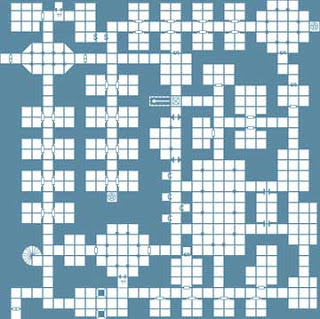 My sole complaint with it so far is that, although I'm working with tiles and a background that are all 300 dpi, the final map ends up being a 72 dpi image. I'd really like to keep at 300 dpi to ensure a fresh, clean printed image. I can resize the finished map into 300 dpi but the end result is a bit blurry. If anyone has any input as to what I might be doing wrong or a workaround to this issue, I'd be extremely grateful.
My sole complaint with it so far is that, although I'm working with tiles and a background that are all 300 dpi, the final map ends up being a 72 dpi image. I'd really like to keep at 300 dpi to ensure a fresh, clean printed image. I can resize the finished map into 300 dpi but the end result is a bit blurry. If anyone has any input as to what I might be doing wrong or a workaround to this issue, I'd be extremely grateful.


Friday, April 3, 2009
Stonehell: The Hexperiment – South
The last quadrant of Level 3, The Hexperiment – South, is now available for download.
After an unforeseen delay, I managed to wrap up both the extended two-part section of the Hexperiment and finally put Level 3 of Stonehell to bed. This final section is split down the middle between the second half of the Hexperiment and a few outside rooms and corridors. More odd features and old favorites await.
This section introduces a new player to the mix of Stonehell. A medusa information broker, known as Lachesis and accompanied by her blind ogre bodyguards and a charmed magic-user, lairs off the beaten paths of the dungeon. From this defended position, they keep tabs on the various intrigues and conflicts occurring between the humanoid races of Stonehell with the intent of selling this knowledge to the highest bidder. Like a few other denizens of the dungeon, how the characters approach and react to Lachesis has potential future ramifications to their dungeon exploration. If they approach with money in hand (and heads averted) they could gain a valuable source of information regarding the political situation of the dungeon. Confront Lachesis with swords and spells swinging, she’s going to do her best to destroy them. Even if they overcome her, she might very well escape them to plot and scheme against them from afar. That will complicate matters.
Of course, her charmed magic-user assistant could turn out to be the wild card in whatever relationship develops between Lachesis and the party. She keeps a wary eye on her servant, knowing that one day he may break free of her control and thus need to be dealt with. Until such a time, however, he proves useful to her schemes. If she sees a likely replacement for him amongst the members of the party though, she may choose to substitute their services for his. That’ll be bad for a few people.
I’m looking ahead at the future levels and it looks like we have a cavern complex/mine in store for us on Level 4 and possibly Level 5. There’s also going to be an opportunity for vertical movement – perhaps of the very fast and fatal variety - on the horizon as well. Lastly, I almost never do this and if Stonehell wasn’t a classic-style dungeon I probably wouldn’t take the step, but I think it’s about time we introduced a dragon to our Dungeons & Dragons.
Enjoy the weekend people and I’ll see you back here on Monday with a full five days of content.
After an unforeseen delay, I managed to wrap up both the extended two-part section of the Hexperiment and finally put Level 3 of Stonehell to bed. This final section is split down the middle between the second half of the Hexperiment and a few outside rooms and corridors. More odd features and old favorites await.
This section introduces a new player to the mix of Stonehell. A medusa information broker, known as Lachesis and accompanied by her blind ogre bodyguards and a charmed magic-user, lairs off the beaten paths of the dungeon. From this defended position, they keep tabs on the various intrigues and conflicts occurring between the humanoid races of Stonehell with the intent of selling this knowledge to the highest bidder. Like a few other denizens of the dungeon, how the characters approach and react to Lachesis has potential future ramifications to their dungeon exploration. If they approach with money in hand (and heads averted) they could gain a valuable source of information regarding the political situation of the dungeon. Confront Lachesis with swords and spells swinging, she’s going to do her best to destroy them. Even if they overcome her, she might very well escape them to plot and scheme against them from afar. That will complicate matters.
Of course, her charmed magic-user assistant could turn out to be the wild card in whatever relationship develops between Lachesis and the party. She keeps a wary eye on her servant, knowing that one day he may break free of her control and thus need to be dealt with. Until such a time, however, he proves useful to her schemes. If she sees a likely replacement for him amongst the members of the party though, she may choose to substitute their services for his. That’ll be bad for a few people.
I’m looking ahead at the future levels and it looks like we have a cavern complex/mine in store for us on Level 4 and possibly Level 5. There’s also going to be an opportunity for vertical movement – perhaps of the very fast and fatal variety - on the horizon as well. Lastly, I almost never do this and if Stonehell wasn’t a classic-style dungeon I probably wouldn’t take the step, but I think it’s about time we introduced a dragon to our Dungeons & Dragons.
Enjoy the weekend people and I’ll see you back here on Monday with a full five days of content.
Design Tidbit
 Consider this a design note and a bit of clarification of detail for Level 3D: The Hexperiment – South. The iron sculpture located in the center of the reflecting pool in room 15 is based on a real kinetic sculpture but it might be obscure to anyone who has never been down to Greenwich Village in New York City. That piece is entitled “Alamo” and was created by the sculptor Tony Rosenthal. Denizens of NYC know it by its less formal name: “The Astor Place Cube” or simply, “The Cube.”
The Cube spins on its vertical axis if pushed and, if you have enough people pushing, you can get it spinning a quite a good clip. I discovered this fact during my misspent punk rock days in lower Manhattan, during a time when it wasn’t uncommon to see a bunch of drunken punks spinning the Cube at 3 o’clock in the morning. I was one of them.
It’s a landmark down in the Village; one easily identifiable to anyone who has spent a lot of time in lower Manhattan. I myself have a lot of fond memories of my excursions down to the Village during my wilder days and the Cube plays a part in several of them. Deciding to include a homage to the Cube in Stonehell is a nod back to those days and a reminder that I’m the person that I am today because of those times and experiences.
Just a note of personal interest, not one that affects game play. I just felt like sharing.
Wednesday, April 1, 2009
The Lost City of Z
 Unlike many aficionados of fantasy role-playing games, I don’t have a particular fondness for Medieval Western history. I’m acquainted with it, largely stemming from my exposure to it as reference material for the hobby overall, but I’m not wont to read treatises on the Dark Ages or the medieval period for my own personal edification. Instead, I have a certain fascination for the historical period that spans from the end of the American Civil War to the end of World War I and the Great Depression. That brief period of years is much more interesting to me, as it bears the characteristics of the modern age in an embryonic state, giving us glimpses of the world in which we now live in a much rougher and quasi-legendary form than that of our day-to-day lives. From the taming of the frontier, the scientific advancements (Edison, Tesla, and Marconi), the wholesale loss of life in the Great War, and the rise of the artistic movements that shaped our modern culture, this time period is more intriguing to me than the age of castles, crusades, and feudal society.
It was with much excitement then that I discovered David Grann’s The Lost City of Z, a book concerning the life and mysterious fate of the British explorer, Percy Harrison Fawcett. Fawcett has been regulated to a historical footnote nowadays, almost unknown by anyone without an interest in the period of exploration that occurred in the late 19th and early 20th century, but during his time he was considered one of, if not the most, successful explorers of the Amazon region. A veteran of several campaigns into the Amazon jungle to explore and map the region, Fawcett, accompanied by his son, Jack, and Jack’s friend Raleigh Rimell, set out to locate what Fawcett referred to as “Z,” a lost city that he hoped would prove his theory that the Amazonia Indian tribes were descended from a highly advanced civilization. On May 29, 1925, Fawcett made one last communication to his wife, and then vanished forever into the jungle. His ultimate fate remains a mystery to this day.
The Lost City of Z is one part historical account, one part biography, and one part an investigative attempt to solve the mystery of Fawcett’s disappearance. The author, having gained access to some of Fawcett’s personal papers long restricted from public view, travels to Brazil in an attempt to track down Fawcett’s trail, now some eighty years gone cold.
The book is worth reading for Grann’s biographical work on Fawcett alone. Fawcett was a man of contradictions: a product of Victorian prejudices who nevertheless was captivated by the “savage” tribes of the Amazon, a family man who felt most at home away from it, and a rational man with a well-ordered mind who eventually succumbed to a fatal obsession, which cost both himself and his son their lives. Fawcett’s exploits in the Amazon inspired Arthur Conan Doyle to write The Lost World, using Fawcett’s discoveries in the jungle as that work’s framing device. As a member of the Royal Geographical Society, Fawcett was considered by many to be the epitome of the British “individualistic explorer” – a man who could venture into the unexplored corners of the world with nothing more than a compass, a machete, and a sense of divine purpose. He was renowned for his almost uncanny constitution: where other men succumbed to disease and illness, Fawcett seemed immune. He was also immune to the pleas for respite and mercy from his exploration co-members. He had little patience for “pink-eyed weaklings” and made it very clear that any man who grew too ill or injured to keep up with the party would be abandoned to die.
As intriguing as Fawcett might have been, however, the book really shines as it details the worlds through which the explorer moved. From the halls of the Royal Geographical Society to the “Hell Verde” of the Amazonian jungle, Grann captures the nuances of those worlds in fine detail. These chapters are of particular interest to role-playing hobbyists as there is much to be pilfered from these pages.
Anyone considering running a “Green Hell” adventure – one where the party must confront the unmapped expanses of the jungle primeval – is encouraged to read The Lost City of Z. In addition to the ubiquitous dangers of the jungle in the forms of piranha, leopards, anacondas, and hostile Indians, the book covers the various diseases and insects that plague explorers unused to this wilderness. The wearying toll of exploration is examined and examples of how even some of the staunchest of explorers succumbed to misery and despair long before their bodies gave out are provided.
As the book covers events that occurred from the end of the 19th and into the first third of the 20th century, The Lost City of Z is a goldmine for Call of Cthulhu keepers and general pulp genre game referees alike. Fawcett’s sudden and complete disappearance inspired not only real life explorers – many who vanished just as completely as Fawcett in the jungle – but writers, film makers, and playwrights as well. Even Indiana Jones encountered Fawcett in the novel, Indiana Jones and the Seven Veils. A very real religious phenomenon sprung up in the wake of Fawcett’s disappearance; some believing that Fawcett discovered a cave that lead to a subterranean city where he discovered the secrets that allows humanity to transcend into another dimension. Fawcett’s dalliances with the occult and Theosophy in order to determine the existence of Z is ripe for the picking of adventure ideas.
For the D&D crowd though, The Lost City of Z provides a very interesting look at the real life world of explorers and professional adventurers – a group of individuals held together only barely by the interests of science, self-promotion, and lasting fame. The backbiting, the dismissal of rival explorers accomplishments as being without merit, as well as the paranoia of being beat to a discovery are all covered in the book. An example of an “explorer’s agreement” – a formal agreement signed by all members of an expedition prior to departure – is provided and makes a good starting point for creating similar adventuring contracts drafted by party members before embarking on a dungeon delve. A quote by a member of the RGS shows insight into the character of professional adventurers and explorers: “Explorers are not, perhaps, the most promising people with whom to build a society. Indeed, some might say that explorers become explorers precisely because they have a streak of unsociability and a need to remove themselves at regular intervals as far as possible from their fellow men.”
While Grann is unable to discover the final fate of Fawcett, Jack, and Rimell – which will, barring some extremely unlikely discovery of their bones in the verdant jungle, forever remain a mystery – he does shed new light on the theory of Z and shows that current scientific evidence seems to indicate there was a kernel of truth to Fawcett’s belief in a lost civilization in the Amazon. Despite this limitation, the book is a glorious trip back to a time when the edges of the world were still less defined than they are today. As this fascination with exploring the unknown is much of the appeal of fantasy role-playing games, I think a reading of The Lost City of Z would benefit and entertain most readers of this blog and encourage you to take the time to seek it out. Hopefully your search will have a much better resolution than that of Percy Harrison Fawcett.
Tuesday, March 31, 2009
Quirks & Qualities Table Available
Now that the pain from my dentist visit has subsided and I'm officially off the "Disco Pillows" and thinking clearly, I've edited the Quirks & Qualities table from last week's post and turned it into a .pdf available for download.
At the suggestion of a commentator to that post, I've included a second version of the table at the end of the document that leaves several entries on the chart blank. This way, referees can add their own quirks and qualities to the table to customize it for their personal campaigns without the need to rewrite or redraw the table in another application. Just pen in your entries and you're ready to go.
I'm back on track for this week and I have a cunning plan for next week. If all goes according to that fiendish plan, look for a full five days of content next week. I feel I've been slacking a bit lately and I want to make it up to you folks.
At the suggestion of a commentator to that post, I've included a second version of the table at the end of the document that leaves several entries on the chart blank. This way, referees can add their own quirks and qualities to the table to customize it for their personal campaigns without the need to rewrite or redraw the table in another application. Just pen in your entries and you're ready to go.
I'm back on track for this week and I have a cunning plan for next week. If all goes according to that fiendish plan, look for a full five days of content next week. I feel I've been slacking a bit lately and I want to make it up to you folks.
Monday, March 30, 2009
I'm Not Myself You See
Last Friday, I had a tooth extracted and I’ve spent the whole weekend in a state of Vicodin conjured half-awareness. Ideas have percolated up to the surface of my consciousness, only to burst like soap bubbles as I try to grasp them and forge them into something cohesive and concrete to display here for your perusal. I have concluded that perhaps deciding to watch both Alien and 2001: A Space Odyssey during my convalescence wasn’t a well-thought idea, as well. Those viewings led to some very strange ideas about the nature of human fear and ponderings about including certain black monoliths in game to explain the uplift of various monsters. Luckily, I doubt these ideas will survive once the medication wears off.
In addition to E.T.I. both malignant and benign, I’ve had some time to think about ghosts, stemming from a reading of Stephen King’s short story, Willa, and how much I still consider Wraith: The Oblivion an overlooked and underappreciated gem of a role-playing game (once you jettison the metaplot and get down to the themes of loss, melancholy, and struggling against the dying of the light, that is). I’ve entertained thoughts about what the MMOPRG world needs is a sci-fi game about the exploration and colonization of unknown worlds; one that had more emphasis on prospecting, building settlements, a player-based market economy, mapping uncharted landscapes, exploring strange alien ruins, and discovering hidden geographic vistas instead of blasting aliens and the other all-too standard MMORPG themes of grinding and “phat loot.” (A game which, as close as I can tell, has only existed something like this in the very early days of Star Wars Galaxies before the need to remain true to the brand exterminated those same facets from game play.)
I’ve entertained notions of working on my hex maps for both the surrounding areas of Stonehell and for my Gamma World hex-crawl, but I haven’t been cognizant enough to do more than lightly brainstorm (braindrizzle?) in that regard, so no progress was made. I’ve been aware that I still need to finish the last bit of the third level of Stonehell and make that available, but that will have to wait until I’m done with painkillers in a day or two. A .pdf of the quick and dirty snowflakes chart also needs addressing. My apologies on both of those the delays.
In short, this has been a very long and roundabout way of saying I’ll be back on Wednesday once I make my way out of Burroughs/Castaneda County and return to the world of more solid ideas and soundings. I’ll see if I can bring home any souvenirs from the sojourn.
In addition to E.T.I. both malignant and benign, I’ve had some time to think about ghosts, stemming from a reading of Stephen King’s short story, Willa, and how much I still consider Wraith: The Oblivion an overlooked and underappreciated gem of a role-playing game (once you jettison the metaplot and get down to the themes of loss, melancholy, and struggling against the dying of the light, that is). I’ve entertained thoughts about what the MMOPRG world needs is a sci-fi game about the exploration and colonization of unknown worlds; one that had more emphasis on prospecting, building settlements, a player-based market economy, mapping uncharted landscapes, exploring strange alien ruins, and discovering hidden geographic vistas instead of blasting aliens and the other all-too standard MMORPG themes of grinding and “phat loot.” (A game which, as close as I can tell, has only existed something like this in the very early days of Star Wars Galaxies before the need to remain true to the brand exterminated those same facets from game play.)
I’ve entertained notions of working on my hex maps for both the surrounding areas of Stonehell and for my Gamma World hex-crawl, but I haven’t been cognizant enough to do more than lightly brainstorm (braindrizzle?) in that regard, so no progress was made. I’ve been aware that I still need to finish the last bit of the third level of Stonehell and make that available, but that will have to wait until I’m done with painkillers in a day or two. A .pdf of the quick and dirty snowflakes chart also needs addressing. My apologies on both of those the delays.
In short, this has been a very long and roundabout way of saying I’ll be back on Wednesday once I make my way out of Burroughs/Castaneda County and return to the world of more solid ideas and soundings. I’ll see if I can bring home any souvenirs from the sojourn.
Sunday, March 29, 2009
Old School Goodies
I've been out of action for most of the weekend but I'd be remiss if I didn't draw your attention to the following three items:
 The Art of the Old School Renaissance!
Produced by Matt Finch and chock-full of the cool art you crave, evoking a time before fantasy heroes had piercings and lattes of cure moderate wounds, we are producing this book jointly in an effort to win the lulu Author Sales Contest. Currently Fight On! is in third place and Knockspell is in seventh place, and we want to get both publishers in the top three to send a statement to the world that classic fantasy roleplaying is back with a vengeance!
Costing $9 and available for purchase from either of our webstores,
Swords & Wizardry Storefront
Fight On! Storefront
buying this will help put one or both of us over the top in the final contest standings! Heck, buy one from each store and give the extra to a friend – you can combine shipping on lulu even when your products come from different sources. And while you’re at the stores, don’t forget to check out Fight On!, Knockspell, Swords & Wizardry, and all the other great products that we have for sale. All products must be purchased by the end of March to count for the contest, and as of April 1 both these special editions will be gone forever, so don't delay. Thanks for your time and interest!
 Fight On! Limited Edition Compendium
To try to boost sales for the contest we are offering a unique product.
Limited Edition Fight On! Hardback Compendium
This is all four issues of FO bound together in a hardback in exactly the order and format they were originally published in. All covers except the front cover of 1 and the back cover of 4 have been made B&W and put on the interior.
We have deliberately made the price higher than the price of ordering the four issues separately, so people who already bought them seperately don't feel robbed. In fact, it's a better deal to buy all four paperback issues separately, and if you're new to the magazine we'd prefer you'd do that since it gets us four sales for the contest instead of one, but some people will want this volume in addition to their regular issues or prefer the hardbound format for some reason.
We are pulling out all stops to try to win this contest!
This and all other special edition products will be pulled from the FO! page on April 1, and then this temporary delay from publishing issue 5 will be over.
 Castle of the Mad Archmage March Release Now Available
Joseph of Greyhawk Grognard continues his efforts to document the dungeon depths beneath the Castle of the Mad Archmage. Level Four, "The Lower Dungeons", is now available for download at his blog. In Joseph's own words:
"This level was challenging in a variety of ways. It's very different in nature than the first two, in that it is a "live" level, with the vast majority actively controlled by various factions with the exception of a couple areas in the periphery. Explorers are very likely to get swept up by one of the four factions and pressed into service in the Arena; I hope that nature of the level came through in the text. I was also struck by a horrendous case of writer's block; it wasn't until I came on the idea of having the Arena still in use that it all snapped together. Once I had that epiphany, it all pretty much wrote itself. I'm particularly fond of the new monster-- the earwig-- although it doesn't exactly have a prominent role in the level."
Drop by Greyhawk Grognard and pick up the collected series as a free .pdf.
 The Art of the Old School Renaissance!
Produced by Matt Finch and chock-full of the cool art you crave, evoking a time before fantasy heroes had piercings and lattes of cure moderate wounds, we are producing this book jointly in an effort to win the lulu Author Sales Contest. Currently Fight On! is in third place and Knockspell is in seventh place, and we want to get both publishers in the top three to send a statement to the world that classic fantasy roleplaying is back with a vengeance!
Costing $9 and available for purchase from either of our webstores,
Swords & Wizardry Storefront
Fight On! Storefront
buying this will help put one or both of us over the top in the final contest standings! Heck, buy one from each store and give the extra to a friend – you can combine shipping on lulu even when your products come from different sources. And while you’re at the stores, don’t forget to check out Fight On!, Knockspell, Swords & Wizardry, and all the other great products that we have for sale. All products must be purchased by the end of March to count for the contest, and as of April 1 both these special editions will be gone forever, so don't delay. Thanks for your time and interest!
 Fight On! Limited Edition Compendium
To try to boost sales for the contest we are offering a unique product.
Limited Edition Fight On! Hardback Compendium
This is all four issues of FO bound together in a hardback in exactly the order and format they were originally published in. All covers except the front cover of 1 and the back cover of 4 have been made B&W and put on the interior.
We have deliberately made the price higher than the price of ordering the four issues separately, so people who already bought them seperately don't feel robbed. In fact, it's a better deal to buy all four paperback issues separately, and if you're new to the magazine we'd prefer you'd do that since it gets us four sales for the contest instead of one, but some people will want this volume in addition to their regular issues or prefer the hardbound format for some reason.
We are pulling out all stops to try to win this contest!
This and all other special edition products will be pulled from the FO! page on April 1, and then this temporary delay from publishing issue 5 will be over.
 Castle of the Mad Archmage March Release Now Available
Joseph of Greyhawk Grognard continues his efforts to document the dungeon depths beneath the Castle of the Mad Archmage. Level Four, "The Lower Dungeons", is now available for download at his blog. In Joseph's own words:
"This level was challenging in a variety of ways. It's very different in nature than the first two, in that it is a "live" level, with the vast majority actively controlled by various factions with the exception of a couple areas in the periphery. Explorers are very likely to get swept up by one of the four factions and pressed into service in the Arena; I hope that nature of the level came through in the text. I was also struck by a horrendous case of writer's block; it wasn't until I came on the idea of having the Arena still in use that it all snapped together. Once I had that epiphany, it all pretty much wrote itself. I'm particularly fond of the new monster-- the earwig-- although it doesn't exactly have a prominent role in the level."
Drop by Greyhawk Grognard and pick up the collected series as a free .pdf.
Subscribe to:
Posts (Atom)