Showing posts with label world-building. Show all posts

Thursday, January 10, 2013

The Ashgate Academy

I’ve been a vocal advocate for the “shared world” experience in role-playing games. Although the referee is responsible for the majority of the heavy lifting when it comes to detailing the campaign world, I don’t believe he or she should be the only one carrying the load. As a game master, I encourage player creativity to help fill in the unpainted corners of the world we’re all exploring and experiencing together. It not only jump-starts my own creative process, but allows for a greater investment in the setting on the part of the players.

The following is a result of that refereeing style. In my Kingmaker Pathfinder game, the party’s wizard often refers back to his time at the magic university he studied at prior to his adventures in the Stolen Lands. Player Rich has elaborated a wonderful backstory about how his wizard paid his way through college as a bootlegger brewer and regularly provides bits of information and lore with the preface “When I was studying magic in Strormfast…” I, for one, believe such creativity should be rewarded, and, inspired by Rich’s anecdotes, have sketched out a brief description of the hitherto unnamed university his wizard attended. Rich’s wizard is of the evoker school and, based upon his usual method of prying information from prisoners, I thought the benefit provided for studying evocation at the Ashgate Academy is fitting.

The Ashgate Academy can easily be dropped into any 3.5 or Pathfinder campaign with a name change or two. Older editions of the game can utilize the Academy with a little mechanical tweaking.
Ashgate Academy 
Founded in 1499 G.C.R., the Ashgate Academy is one of the few renowned and respected schools of the magical arts in the harsh northern kingdoms. Situated in Strormfast, the college earned its name from the site of its construction. The Academy stands at the base of Pyre Cliff, the traditional site of cremation for the city’s dead. Following the incineration of the deceased’s mortal remains, the funeral procession bearing the ashes pass through a wrought-iron gate erected at the base of the cliff. The Academy’s main building faces this “Ashgate,” thereby earning its designation. The Academy’s sigil is a crimson flame inside the archway of an argent gate on a field of deep azure.

The Ashgate Academy is best known for producing exceptional practitioners in the schools of enchantment, evocation, and necromancy. Instructed by masters of these magical arts, the graduates of these three schools enjoy a minor benefit from their education. These benefits manifest as follows: 
Graduates of Ashgate Academy’s enchantment college are well-schooled in the identification and classification of magical auras. Enchanters of the Ashgate Academy gain a +1 circumstance bonus on Spellcraft checks made to determine the school of magic involved in a magical aura or to identify the properties of a magical item when using the detect magic spell. 
Graduates of Ashgate Academy’s evocation college are famed as battle wizards and feared for their ability to rain destruction down upon enemies. Evokers of the Ashgate Academy receive Intimidate as a class skill. 
Graduates of Ashgate Academy’s necromancy college receive intense training in the funeral practices and beliefs of many diverse cultures. Necromancers of the Ashgate Academy receive a +1 circumstance bonus on Knowledge (religion) skill checks regarding funeral rites, afterlife symbolism, and the identification of deities possessing the Death domain.

Saturday, August 4, 2012

How Painter, NY Got Its Name

I decided to treat myself this evening and put some design work aside so I could play with my own creations for a change. I’m in the midst of laying the groundwork for a Call of Cthulhu campaign set to start in the late summer/early fall and that means more paranormal fun in Wildwyck County. The first investigation focuses around the small hamlet of Painter, NY. Those of you who have Fight On! #13 will find it in area A3 in the map on the magazine’s back cover.

Half the fun for a Call of Cthulhu Keeper is creating the background and evidence an investigation requires. The following emerged from this enjoyable aspect of writing an adventure, but it’s a little too long to be included in the gazetteer portion of the Wildwyck County series of articles so I’m sharing it here.

Located in the upper northwest part of Wildwyck County is the tiny hamlet of Painter, NY. Situated at the edge of the Catskill Mountains with the towering crags of Windswept Mountain staring down at it, Painter is a quiet and quaint community far off the beaten path. With slightly more than 200 residents in the hamlet’s central community, Painter is only occasionally visited by hunters and outdoorsmen seeking recreation in the wilds of the mountains beyond.

Although the name conjures up images of bohemian artists at work, the town’s name is actually a regional derivation of the word “panther,” and its origin can be traced back to an event which occurred prior to the American Revolution. That tale, recorded by the author Allen Vanderlyn in his book, Curious Tales and Fanciful Legends of Wildwyck County (Royal Oak Press, 1901), appears below:

Simon De Witt had a frightful encounter with the catamounts along the shore of the pond that now bears his name. One of the many brilliant silver oases found throughout our fair county, this pond was conspicuous, in times gone by, for its large trout, and for the numerous deer that took drink from its waters. One day in late summer, De Witt visited the pond in search of deer. He sat beneath a towering tree that stood watch over the pond’s tranquil waters, waiting for his quarry to come. While thus engaged, his attention was drawn to a curious sound above him, and looking up, De Witt glimpsed a large catamount (or as was known in the dialect of the time, a “painter”) perched on a branch directly overhead. The animal stared down at him intently with luminous eyes as if internally discussing the merits of taking De Witt for his supper rather than a succulent doe. Believing there could be no benefit in procrastination, De Witt brought his musket to his shoulder and fired. The next moment he heard the satisfying sound of the great feline hitting the ground at his feet, the turf and fallen leaves now awash in crimson.

The report of his shot startled other feline forms in activity amongst the tree-tops and De Witt feared the wood filled with painters. Fear clutching his chest, the hunter realized his great peril.

Knowing the aversion the cat-tribe bears for water, De Witt waded into the pond up to his waist. As he reloaded his musket, taking great pains to avoid wetting his powder as his endeavored to complete his task with alacrity, De Witt counted no less than five panthers amongst the shoreline trees. This number is uncommon for catamounts, who hunt not like wolves in packs, but as solitary terrors, and the hunter concluded the beasts to be a mother and young; the latter being nearly full-grown yet continuing to follow the older cat on the prowl.

The hunter unleashed a fusillade of shots aimed at his sinuous foes from the pond, bringing down three more of the beasts in swift succession. The other two took to flight and were seen no more. De Witt then waded ashore, skinned the four painters and made his way homeward, sensibly concluding that it was a dangerous locality for the pursuit of a venison supper.

The legend of De Witt’s encounter—spread largely by the hunter himself—became a popular one in the ‘Wyck amongst the homesteaders and eventually grew to be part of the local canon of myths. When the first residents arrived in the area in 1817, they named the nascent settlement after the numerous beasts that legend held ruled the sylvan vale and dubbed the waters that pooled there “De Witt’s Pond” in honor of the legendary hunter.

I’ll leave it up to the reader (and the investigators) to decide whether this story has any truth to it or if it’s just a frontier “tall tale” or perhaps a bit of a red herring devised by a fiendish mind to throw them off the track of what might be really occurring in the shadows of the Catskills. If there is some truth to it, what could it mean? Are there were-panthers prowling the woods of the ‘Wyck? Could there be a temple dedicated to Bast erected by Hyperborean refugees hidden in the mountains? Did De Witt later meet a horrible demise when he wandered into the Dreamlands and found himself in Ulthar? I know, but I’m not telling…

Tuesday, January 31, 2012

From the October Country: 'Naut Fights

One of the many purposes of the October Country setting is to give me a world where I can put all the genres and stories I want to experiment with in one place. It’s really a microcosm (or perhaps it’s a macrocosm) of my interests on display for all to see. When the setting is complete, the players and referees will find a wide variety of people, places, and things to power their adventures—many of which are very far removed from traditional fantasy.

As much as I pretend to be aloof from it, I am susceptible to popular culture and the current climate of entertainment. That includes advertizing, movies, and other popular trends. Lately, I’ve been seeing a hell of a lot of commercials for the movie Real Steel, a film where Wolverine builds a boxing robot and uses it to bond with his son. And while I’m not a big fan of machine-on-machine violence, the idea of gladiatorial matches between constructed warriors does tickle my fancy a bit. So I decided to add it to the October Country. I already had a region where it would be a natural fit, so why not? Even better, this made me to think about how I’d implement it in the campaign. That led to the creation of a mini-game that I’m currently working on. If I’m lucky, I might test the basic rules after my weekly game session on Sunday. But, without further ado, here’s a brief guide to ‘Naut Fights in the October Country.

High in the northern mountains, where stands of firs and lightning-struck pines grow thick on the granite peaks, is the legendary domain of the Lightning Lords. Secretive sorcerers of technology, the Lightning Lords tap the elemental forces of nature to birth miraculous constructions and machines rarely seen outside of their savagely beautiful country.

This devotion to their science comes at a cost: very few have the luxury of stepping away from their laboratories to attend to mundane matters. This lack of attention extends from simple matters such as hygiene to more complex concerns like the security of their borders. But, as men of science, the Lightning Lords long ago created a means to deal with certain pressing matters by means of mechanical proxies. No greater example of this exists that the famous ‘Naut Fights of the Lightning Lands.

Whenever two or more of the Lords come into conflict, be it over borders, resources, or the shared network of wires that channels lighting down from the heavens and throughout the nation, disputes are settled not on the battlefield, but in the arena. Each Lord activates one of his stable of Juggernauts (commonly called simply ‘Nauts) and the combatants battle it out in a formal duels attended by the Lords’ servants and seneschals. The Lord whose champion wins the bout has his way in the matter under dispute and the disagreement is put to rest. It is extremely rare for the losing party or parties to dispute this—partly because of tradition, but mostly because they lack the time to submit a formal protest to the informal council that arbitrates the myriad baronies that comprise the Lightning Lands.

These duels are seldom to destruction—the cost to build and maintain a stable of ‘Nauts is high and the strange susceptibility to deterioration that technology in the October Lands already deals with is enough to convince a losing ‘Naut’s master to throw in the towel. The battered ‘Nauts are pulled from the arena to be repaired by the Lightning Lords’ crews of Gearheads, those uncanny argents of the Clockwork Man who keep technology functioning beyond the Pale.

A ‘Naut is a wonder to behold. Standing near 10’ tall, these machines are typically humanoid in appearance and operate on steam, phlogiston, zeusiam, or clockwork engines. Two or more weapons are affixed to each ‘Naut, and close combat is preferred over ranged armaments. Each champion is armored, but the level of protection varies from model to model. Some Lords prefer Hulk Class bruisers or Behemoth bashers, while others prefer Springheel skirmishers or Dancer Class athletes. No matter what style meet in combat, one never forgets their first ‘Naut Fight.

What makes these battles so memorable is the skill of the combatants. ‘Nauts do not fight like constructed warriors, animated by gears and fire, but like living fighters that think, strategize, and react much faster and more skillful than a machine ever could. The secret to this is that each ‘Naut is operated by a literal “ghost in the machine.” When crafted, the spirit of a dead creature is attuned to a ‘Naut, allowing the soul of that individual to possess the machine and operate it as if it were its own living body. The ghostly fighters serve their masters for a variety of reasons and are usually well-treated by their individual Lords. Some ghosts have served their Lord’s family line for centuries, becoming legends in their own right and feared by all challengers when met in the arena.

When visiting the Lightning Lands, be it to hire the services of a Gearhead or to book passage on one of the realm’s electrical barges or dirigibles, be sure to attended a ‘Naut Fight. Exhibition matches are commonly held for bragging rights and entertainment, and it is rare for a week to pass without at least one bout occurring in a barony.

Tuesday, December 27, 2011

Lord of the Rings Miniatures Terrain Question

To those readers who are/were either fans of Games Workshops' Lord of the Rings Strategy Battle Game or just followed the GW production schedule in general, a question:

Did GW ever produce this statue as a stand-alone piece or was it always part of their Lord of the Rings Terrain Pack? I could have sworn that I once saw it for sale as a single piece, but all my searching seems to indicate that this was just something I cooked up in a fever dream rather than an actual sighting on the Web. I know for certain that I'm not thinking of a Thomarillion production (although those are quite cool, too), but this particular sculpting based on the statue that appears in the films.

I re-watched the trilogy over the holiday and absolutely love all the little background scenery Jackson sprinkles throughout the films. It does a wonderful job of imparting a sense of history to Middle-Earth and that's something I always shoot for in my own games--successfully or not.

Monday, July 25, 2011

Odd Job for Odd Linguists

Captain America is all in the news lately and I’ll admit that I’ll be waiting for the DVD if ever to catch it. However, the buzz around it got me thinking about Cap’s old nemesis, HYDRA. I was shocked to discover that HYDRA, despite its spelling, is not an acronym. I always assumed it was like S.H.I.E.L.D. and was some god-awful stretch of names to make a cool acronym. Then I was reminded of P.A.G.A.N. (People Against Goodness and Normality) from the forgettable 1980s’ Dragnet movie and one thing led to another.

I’m playing around with a new setting and I want to throw in some enigmatic cabals with weird ass names. The atmosphere I’m going for is League of Extraordinary Gentlemen meets Hellboy—steam-punk, Victorian Era, world-shaking cabals, etc.

It’d be easy to create a half-dozen groups with acronyms that spell out appropriate English words, but I’d like to throw in a few world-spanning evil groups. So, with that in mind, does anyone with a command of a language other than English have any suggestions? The acronym could be a word in any language, but since the target audience is English speaking, an organization whose name “coincidentally” spells an English word would be most appreciative. Perhaps K.R.A.K.E.N. is something particularly fiendish in German, Russian, or even Portugese…

If anyone has any suggestions or personal favorites, I’d love to hear them.

Thursday, March 24, 2011

“Horses! Get yer Horses here!”

Want to make the horse-buying process something more than just subtracting gold pieces from a character sheet? Have a player who simply MUST know what kind of selection the horse trader has for sale? Has it ever occurred to you that the characters’ mounts are NPCs too? If so and you don’t know where to start, download this incredibly helpful PDF that I cobbled together from diverse sources such as Wikipedia and various game supplements. It’s one of the goodies I keep close at hand in my referee binder for just such occasions. Random tables are provided to make horse trading fun again!

Want to know more about horses? Consult your local library or listen to seminal Patti Smith album of the same name:

Friday, January 14, 2011

Krang the Steel God & Quintessential Items

Steel screams when it's forged, it gasps when it's quenched. It creaks when it goes under load. Steel is alive, son.

Krang the Steel God, sometimes known as Krang of the Hammer or the Ever-Smith, is a minor demi-power, but an important one. Krang rules over the tensile strength of steel, the durability of iron, and the ability for those metals to hold an edge. Smiths and soldiers are his usual devotees, but many who rely on metal for their trade or survival will speak a brief prayer to Krang before using an item under his influence. Krang’s holy symbol is a piece of razor sharp steel or iron etched with unusual symbols that spell out the deity’s name in Smithik, the secret trade language of smiths. Krang is aligned with Wonder in the Old Pantheon.

Although Krang has no true priests (spell-casting ones that is), he does possesses a small group of fanatical smiths who are able to invoke the god’s power when crafting an item. This group is known as the Ferrumic. Each Ferrumic smith is a migrant crafter, travelling from settlement to settlement to trade, teach, and, most importantly, search for veins of hematite especially blessed by Krang, for it is these special strains of ore that they need to create the quintessential weapons and armor they are known for.

Quintessential Objects

Ferrumic smiths can create objects using the rare forms of iron ore infused with Krang’s essence. These items are known as quintessential pieces, being superior to even masterwork items. Each has a minor magical effect of limited duration, but is not a true magical item such as one enchanted by magic-users and elves. As such, quintessential objects cannot usually strike creatures only affected by magic item (but see below).

Quintessential objects enjoy the benefits of masterwork items (+1 to attack OR damage rolls in the case of weapons; movement rate improved by one step for armor). Additionally, there is a chance that a quintessential object gains a random magical ability during its creation process. This base chance is 20%. However, the smith can attempt to improve the chance of attracting Krang’s attentions to the crafting process by using rare or exotic substances during the item’s forging. Such materials are expensive and they require an additional expense on the part of either the smith or the one who commissioned the piece. For each additional 100 gp spent, the chance for the weapon developing a spontaneous quality is increased by 10%. The probability may never be increased above 80%, however, and the money is spent regardless of whether the object develops special qualities or not.

Krang is an enigmatic god and even the Ferrumic cannot predict what qualities he might bestow upon their work. If the check reveals that the object is imbued with a special quality, the referee should roll on the table below to determine what power the item possess. Note that each of these abilities can be invoked only a finite number of times, and that, like a wand; each use reduces the number of “charges” the item contains. Each quintessential item has 2d10 uses when first crafted. After all those uses are gone, the item is treated like a regular masterwork item. The object’s owner can attempt to have a Ferrumic smith re-consecrate the item, but such a service costs a flat 500 gp and has only a 50% chance of success. If this attempt fails, the item’s power can never be restored. If it successful, it regains 1d10+5 charges. A quintessential weapon can only be re-consecrated one time.

01-03: Item can throw magic missiles as if it were a 5th level magic-user (3 missiles per use)
04-06: Item unlocks a single, non-magical lock within 5’.
07-10: Item causes any single attack against the owner to be rerolled.
11-13: Item allows the owner to levitate for 1 round per use expended. Movement rate is 20’ per round.
14-17: Item allows the owner to reroll any failed check against fear. This is a reflexive power and requires no action on the part of the owner.
18-21: Item produces a small flame (candle-sized) up to 30’ away.
22-25: Item allows the owner to affect creatures normally only struck by magical weapons. This effect lasts for 1d4+1 rounds.
26-28: Item produces a shocking grasp effect when striking/struck by an opponent, doing d8+1 damage.
29-33: Item allows the owner to ignore the effects of a web spell or giant spider webs.
34-37: Item turns undead as a 2nd level cleric
38-41: Item detects poison within 15’ radius.
42-46: Item can produce light as the clerical spell (12 turn duration)
47-50: Item reduces any fire-based damage taken by half. If the damage allows for a saving throw and it is successful, only one-quarter damage (rounded down) is suffered.
51-53: Item has a 4 in 6 chance of detecting secret doors within 15’ radius.
54-57: Item negates the effects of a sleep spell on the owner only. This is a reflexive power and requires no action on the part of the owner. The owner is still included in the # of HD affected.
58-62: Item resists the effects of corrosive attacks from creatures such as rust monsters, green slime, grey ooze, etc. This is a reflexive power and requires no action on the part of the owner.
61-64: Item cloaks the owner in gloom, increasing his ability to surprise opponents to 3 in 6. The created shadows only affects owner and the surprise chance is cancelled if accompanied by others.
65-68: Item grants the owner a +1 bonus to any single saving throw.
69-73: Item creates water as a 1st level cleric.
74-76: Item allows the owner to blink for 3 rounds.
77-81: Item grants the owner infravision for 2d6 turns.
81-83: Item creates an arcane eye which lasts for 1 turn.
84-87: Item deflects non-magical missile attacks with a successful save vs. breath attacks.
88-91: Item grants the owner a boost of speed that allows him to automatically wins initiative for the next round. It has no other effect. The rest of the party must roll for initiative as normal.
92-95: Item allows the owner to read languages.
96-99: Item prevents the owner from losing his footing. This is a reflexive power and requires no action on the part of the owner.
00: Item becomes a true, permanent magical item of +1 power.

Cost of crafting a quintessential item

The base cost of materials and labor for a Ferrumic smith to create a quintessential item is the item’s normal cost plus 400 gold pieces. This allows for the base 20% chance of the item developing special powers. Additional funds may be spent to increase this percentage as noted above.

Crafting times

The time required to forge a quintessential item depends on its size and complexity. A quintessential weapon can be created in one week’s time. A quintessential shield requires 7+1d8 days to complete. It takes a full month to create a quintessential suit of armor.

Thursday, January 6, 2011

Modern Map Suggestions?

In light of my own advice, I’m giving some serious second thought as to what RPG I’d really like to run after (or even before) my Labyrinth Lord game winds down. There are a few candidates, all of them having the common factor that they are not fantasy-based titles. I need a little break after living, breathing, and most importantly, writing fantasy stuff for the last two-plus years.

Strangely enough, when it comes to modern setting games, my biggest hang-up is mapping. My modern games are more character-driven than location-based, and I’d prefer to spend time diagramming the relationships between various factions and individuals instead of detailing the office that the players operate out of. When such detail is needed, I can always draw upon real-life experience if necessary, quickly sketching out an old work place or what have you to use in a pinch.

The problem with that, however, is that, after a time, all the offices start looking the same, the churches have the same layout, and even the corner store get repetitive. So to combat this, I’m looking for suggestions on gaming resources filled with modern location maps. I see that there are a few such things on rpgnow.com, but the reviews on them are not great. Does anyone have something they can recommend based on actual use?

My only requirement is that it has to be either a PDF (I’m not buying actual books this year) or a web resource. It should also have the widest range of locations possible from the mundane (convenience store) to the uncommon (funeral parlor). I don’t need them to be usable with miniatures, but being able to print them out and keep on hand for the next time the PCs chase the bad guy into a construction site would be a bonus. Cheap or free is always appreciated too.

Any suggestions?

Thursday, December 16, 2010

Visiting the Kinan-M’Nath

Into the whirlpool
Where matter vanishes
Degenerate star
Arm of Orion

An iron sun
The forbidden circle
Anti-matter is the
Black horizon

Blue Oyster Cult, “Heavy Metal: The Black and Silver

Now that visitors know what to expect once they arrive in the Uncertain Lands, how exactly do they get there? For this, we must turn to the sages of the ages, who, in their ink-spattered wisdom, have determined that there are four known methods of transportation between the Kinan-M’Nath and other worlds.

Method #1 – Spell Craft: Perhaps the easiest method of world travel, this method is restricted to those who have achieved mastery in magic, have discovered a magic item capable of cross-world travel, or can pay someone to provide these means of travel for them. In general, spell craft travel covers cross-world travel achieved by use of astral projection, gate, limited wish, plane shift, and/or wish, or through magic items such as an amulet of the planes, a cubic gate, or a well of many worlds. The benefit of this method is that the caster or item user has some control over where they arrive—provided they have some familiarity with the lands of the Kinan-M’Nath.

Method #2 – Realm Storms: Highly unpredictable, those arriving in the Kinan-M’Nath by way of a realm storm seldom do so willingly. These planar tempests tear the boundaries between worlds, although they appear to be nothing more than extremely strong thunderstorms to those caught in them. More than one party of adventurers has sought shelter in a cave during a realm storm only to emerge after it ended and find themselves in a completely different world. Some powerful mages and learned sages can predict where and when a realm storm may next appear, but finding such an individual and meeting their price is an adventure in its own right.

Method #3 – Etheric Mists: Like realm storms, etheric mists are a supernatural event. They are even more unpredictable than the storms, however, and some sages believe that etheric mists are examples of Fate in action. Appearing as a smoky gray fog, etheric mists are cold, thick, and damp, restricting sight to a mere 5’. Alien noises and weird echoes sound from the depths of the mist, and an occasional phantasmagorical shape can be barely discerned. Etheric mists appear without warning, even on the sunniest of days. They envelop travelers completely, last anywhere from several minutes to several hours, and, once they dissipate, leave the wanderers in a new land.

Image by Stefan Poag. Please visit Knucklebones.net for more of Stefan's wonderful work.

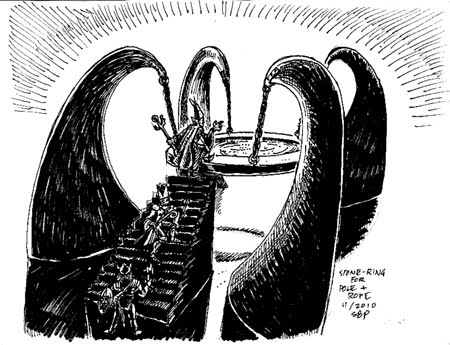
Method #4 – Hangways: These permanent gates were created in the dim past by unknown hands for indeterminable purposes. Appearing as 12’ diameter stone hoops, hangways are typically found suspended horizontally between four massive supports and dangling 10’-12’ above the ground. Usually a set of free-standing stairs or a ramp leads up to the edge of the hoop, allowing travelers easy access to the 8’ diameter opening in the hoop’s center. The air inside this aperture shimmers as if hot, although the temperature is the same as the surrounding atmosphere. Although hangways share the same general appearance of horizontal hoop hanging from supports, details vary from place to place and world to world.

Image by Talysman. Please visit Talysman's blog, The Nine and Thirty Kingdoms, for more.

Hangways, sometimes called “hopgates” due to their method of egress, allow free travel between worlds to specific locations. Unlike the less predictable methods listed above, hangways remain in fixed locations and provide access to a matched site on one or more alien worlds. Use of the hangway is a simple matter of hopping through the horizontal aperture and falling between worlds. The traveler lands unharmed on the floor underneath the other hangway’s matched hoop on a new world. Travel between world can only occur by stepping through the topside of the hangway’s hoop. Attempts to reenter a hangway from below are always unsuccessful.

Image by Talysman

While the majority of hangways are keyed to a single location, some allow access to multiple planes. Hangways with multiple connections are usually time-based, meaning that a single hopgate will connect to one place during a certain time of the day, week, month, or year, and connect to another at an alternate time. Sometimes manuals, instructions, carvings, etc. are found near these types of hangways, but this is not guaranteed. Adventurers intending to travel via hangways should research their chosen hopgate carefully before embarking on their journey.

Hangways are the most common planar gate found in the Kinan-M’Nath. At least two are known to exist within the boundaries of Stonehell Dungeon; others can be found in forgotten places (both indoors and out) across the Uncertain Lands. The most recent wayfarers to arrive through a functioning hopgate are the members of The Society of Planewalkers, currently operating out of Blackpool. These outsiders purportedly originated in the Lands of the Rotted Moon and have displayed talents and traits unusual to the Kinan-M’Nath. Whether they will become a force for the Weal or the Woe remains to be seen.

A Note About the Duration of Stay: Visitors to the Kinan-M’Nath should be aware that their method of travel to the Uncertain Lands may have an impact on how long they remain in that world. Etheric mists and realm storms are notorious for carrying a person or persons between worlds only to return them to their place of origin days, even hours, later. And while spell craft and hangways almost always allow for unlimited visitation, even these methods have been known to abruptly fail, resulting in the traveler’s sudden departure from this realm. In other words, the referee has full control over the length anyone visits his campaign, making it much easier for a guest PC to suddenly fade away and return to his own campaign world if needed at the end of a session.

A very, very heartfelt thanks to Stefan Poag and Talysman for taking the time to contribute their talents to an unconventional idea dreamed up by me on a whim. Your contributions are greatly appreciated!

Friday, November 26, 2010

Illustrating A Crazy, Cool Idea

I’m spending the long weekend working on the myriad little projects that always seem to clog my mental inbox. One of those is to get caught up on my copies of Fight On! magazine. Since it’s been awhile, I’ve started at the beginning, rereading #1 and working my way forward. One of the articles in that magazine got me thinking and I want to do a more in-depth post on my thoughts in the weeks to come. I’m going to introduce something and I’d like to have an illustration to go along with it.

I’ve posted a rough diagram of something below. As you can plainly see, my artistic talents are limited to the written word (and there are those that would debate even that claim), so I would be very interested to see what someone with some talent could do with the below sketch.

Normally, I’d say send me an email if you’re interested it cleaning this doodle up, but, for my latest crazy idea, I think the more variations on this theme, the better. Therefore, I’m open to as many takes on the sketch as people are willing to submit. It actually works to the idea’s and the upcoming post’s benefit to have plenty of options.

If you are so interested, please take the attached drawing and run with it. You can recreate it as is, take the rough idea and elaborate on it, or just use it for the most meager bit of inspiration. Work in any medium you wish. When you’re happy with it, send me either a copy of your creation or a link to where I might view it. I will post your picture here in conjunction with the article giving you full credit for your work. If it takes a bit for you to finish up, and you do so after the post appears, please send it to me anyhow and I’ll post follow-ups to the original from time to time.

I’m not out to make any money on this idea and the article the illustrations accompany will be posted here for all to see. I can only give you the opportunity for your work to be seen by a fair number of individuals in return for your efforts.

I think my idea has some merit and I’m hoping others will jump on the idea and embrace it once it’s revealed. Please help me with your own talents. You can contact me at poleandrope (at) gmail (dot) com to submit your work or make other inquiries.

Thank you very much in advance.


Monday, September 20, 2010

“Meanwhile, back in town…”

The last game session saw the PCs beginning to look around at the larger world picture and realizing that there may just be more to the Kinan-M’Nath than that old prison up in the hills. I’m hoping this is the start of a trend.

The adventurers have learned that Stonehell is not a static location that patiently waits for them in between their expeditions. Things are occurring down in its depths all the time, and some of those events have lasting effects on the dungeon as a whole (which reminds me that I need to make the latest batch of changes to the site). Obviously, the town of Blackpool is also a dynamic place that changes over time. I have a randomly determined a few big events that might occur in the future of the overall sandbox, but haven’t dabbled with the idea of local events. Until now, that is.

What follows is a rough draft of random notable events that could occur in and around the PC’s home base. I’m still tweaking, but this is closer to finished than not. I’ve riffed on the results to give them possible adventure seeds or unexpected twists, but I don’t plan on doing more with them until they come up in actual play.

I’ve experimented a bit with probability of these events occurring and decided to go with a 1 in 8 chance of an event occurring each day (rather than my original plan of 1 in 6). That seems to ensure that at least one interesting event occurs each month, but not so many as to turn town into a madhouse. I also considered staggering the results to make some more likely than others, but decided to make it a straight d20 progression just to keep me and the players on our toes. I plan to roll at least two weeks if not more in advance so that I can give the events a proper lead in, making them appear to happen naturally, rather than be spontaneous occurrences (except in cases where the very event is unexpected). Since I often get asked to do this anyway, you can find a PDF of the following table and its explanations here.

What’s Going On? Roll a d20 to find out!
1) Fire
2) Child goes missing
3) Accident
4) Bandit attack
5) Murder
6) Monster on the prowl
7) Theft
8) Destruction of property
9) Illness
10) Birth/death
11) Execution
12) Festival
13) Sign from the Gods
14) Mustering the troops
15) Windfall
16) Visitor
17) Magic!
18) Rumors
19) Quarrel
20) High weirdness

Accident: A worker is crushed by falling stonework at the keep or someone is grievously injured at one of the sawmills. If a PC cleric is nearby when this occurs, he or she may be able to save their life, earning them the undying friendship of the victim and her or her family.

Unexpected twist: If the victim dies, his or her survivors blame the overseers at the job site and want revenge. An unscrupulous PC might be approached to handle that task.

Bandit attack: A merchant caravan is attacked on its way to or from town. Many are slain. There is a 50% chance that the caravan was carrying needed supplies or that word of the attack spreads outside the immediate area, resulting in a slow-down of traffic on the roads. Prices of all important goods (read: anything the PCs are likely to buy) is increased by 10%-20%.

Unexpected twist: The caravan was carrying an important MacGuffin that someone of importance needs recovered immediately. He or she is offering a reward if the item is retrieved before the next sunset.

Birth/death: Someone comes into or goes out of the world. There is a 10% chance that this event occurs to someone the PCs know in town. Otherwise it is simply a popular topic of conversation for the next day or two.

Unexpected twist: The PCs find themselves involved in some manner. If they have recently done great deeds to assist the community, a newborn child might be named after one of them and one PC is named as the baby’s “sword-uncle (or aunt).” This will require attending a special ceremony and the purchase of a gift (the more lavish the better) for the child and/or his family. If it is a death that occurred, the departed might be of the same faith as one of the PC cleric and require him or her to conduct the funeral, or the deceased may have left one or more of the adventurers something on his deathbed. Why they did this remains to be determined.

Child goes missing: One of the local children fails to return home after heading into the forest or down to the river. A search party is forming in the town square. PCs who willingly join in on the search will find that the residents hold them in slightly higher regard afterwards.

Unexpected twist: Rather than find the child, a crudely written ransom note is discovered. What the kidnapper wants in return is highly unusual.

Destruction of property: For some reason, something breaks. It could be a fishing pier swept away by a rain-swollen river, a stretch of road collapsing into a sink hole, a statue shattered, or the local cemetery defiled. Depending on the exact nature of the damage, the townsfolk might pitch in to repair the damage, demand the Lord Warden take action, or sit around grumbling that “things aren’t what they used to be.” PCs who pitch in or pay to help repair the destruction will earn the respect of the residents. Those who were nearby when the damage occurred will be watched carefully and whispered about.

Unexpected twist: The damage unearths a new mystery. A drowned body might be found chained to one of the remaining pier posts, a tunnel found under one of the overturned headstones in the cemetery, or an interesting find is discovered hidden inside the statue’s hollow form.

Execution: If a prisoner is being held in the keep on serious charges, his execution is schedule for today. If no one is being held, a local outlaw has been caught and is bound for the gallows. An aura of macabre anticipation hangs over the town and most residents plan on attending. Business will be closed for an hour before and after the execution. There is a 10% chance the something unusual occurs to the condemned’s corpse in the days following the sentence.

Unexpected twist: A new development occurs just prior to the execution. This could be the unearthing of new evidence that questions the guilt of the condemned or it could be a last minute rescue effort launched by the convict’s companions. The PCs may easily find themselves in the thick of things.

Festival: Today is either a minor holiday or the day that a celebration such as a wedding, coming-of-age, or funeral is to be held. As such, the town is adorned with decorations and business as usual is suspended. If it is a religious holiday, there is a 75% chance it is a day sacred to one of the faiths in town. If it is not that of one of the settlement’s religions, there is a 15% chance it is one sacred to one of the PCs’ religions (provided they follow a faith not represented in town).

Unexpected twist: There is a 20% chance that something eventful occurs during the festival. Roll or choose from the event table above, ignoring any result that seems unlikely.

Fire: One of the buildings in town catches fire. There is a 66% chance that the structure is destroyed by the blaze and a 40% chance that any adjoining buildings catch fire as well (with similar chances of being destroyed).

Unexpected twist: Someone was seen fleeing the area immediately before the fire. It appears to be arson. Who did this and why?

High weirdness: Something so strange or unexpected occurs that nobody could have seen it coming. A gargantuan helmet falls from the sky and lands in the town square. A purple worm erupts from the ground and swallows the butcher’s shop. One of the residents gets a nocturnal visit from the “dwarfs in black.” In any case, things are going to be most unusual in town for the near future.

Unexpected twist: This entire event is an unexpected twist.

Illness: A sickness is making its rounds through the town. On a roll of a 1-3, it is a minor aliment such as the flu or chicken pox. On a 4-5 is a more serious ailment such as cholera or dysentery. On a 6 it is the plague. Roll again on a result of 6. Should the die come up another 6, the disease is magical in nature and could even be a curse such as lycanthropy or vampirism.

Unexpected twist: Some mastermind is behind the illnesses. It could be goblins bathing in the water supply, a mummy sorcerer getting his long-delayed revenge, or even be caused by the innocuous looking doodad the PCs picked up on their last adventure and sold to the local curio shop.

Magic!: A magical event occurs to brighten up the dreary lives of the townsfolk. A wandering wizard comes to town with his pyrotechnics show, a local mage inadvertently transforms himself into a strange form or blows up his lab, or a magic artifact is discovered in the course of daily life. The Lord Warden’s sorcerer is bound to investigate such matters.

Unexpected twist: It is one of the PC magic-users that becomes the focus of this attention—deservedly or not.

Monster on the prowl: Some creature (determine randomly) was detected close to town. Depending on the threat level, the townsfolk might form a posse, called out the guard, or hire adventurers to hunt down and remove the threat.

Unexpected twist: The “monster” is of a neutral or good alignment and may be seeking assistance on some matter. Or it could just appear to have good intentions…

Murder: Someone in town dies by violence. This could be due to a brawl, a duel, or an assassin. There is a 50% chance the murderer is in custody at the keep. If not, the culprit is either on the lamb or unknown. This will be the topic of conversation for the next several days.

Unexpected twist: Someone swears they saw the victim alive and well after they were killed. This could be a case of simple misidentification, the result of disguise magics, or a doppelganger at work.

Mustering the troops: The local military is assembled. This may be a simple case of the twice-yearly mustering of the militia to ensure their readiness and inspect their weaponry or it could be an actual military conflict. In the later case, a portion of the keep’s soldiers are needed to combat a threat. This might be a matter of assisting another nearby settlement to deal with a problem, or it may be that a great threat to the security of the settlement has been detected and must be dealt with immediately. In either case, the PCs could become drawn into the conflict, be hired as mercenaries, or find they need to lie low to avoid being pressed into service.

Unexpected twist: This assembly reveals that the local soldiery is woefully unprepared in some manner. The troops’ arms or armor have become unserviceable or perhaps even stolen, leaving the troops under-equipped. Clever PCs might take it upon themselves to go into business as arms-merchants, collecting the cast-off arms and armor of their foes and selling it to the local quartermaster at an inflated price.

Quarrel: Two parties in town find themselves in conflict. The reason for this could be mundane but scandalous (somebody was caught stepping out on their spouse) or serious and potentially fatal (two merchants are locked in a feud that comes to blows or a pair of soldiers prepare to duel over the affections of a woman). Depending on the conflict, the PCs could become involved if an ally (or enemy) is part of the quarrel or if their personalities make them the mediating-type.

Unexpected twist: This quarrel is the result of a much deeper scheme. The two parties might have been lured into conflict so that a third person can benefit from their feud in some manner. This plot could have severe repercussions on the security and future of the settlement should it come to fruition.

Rumors: One piece of information seems to be on everybody’s lips but nobody can identify where this information came from. To make matters worse, everyone seems to have heard a different variation on the tale. This piece of news could be joyous (“The Grand Price is coming to look for a bride!”) or grim (“The Armies of R’kee are marching east!”). In either case, not only will this be the talk of the town, making it difficult to learn more concrete and useful rumors, but it could affect day-to-day business (there is a run on arrows and bolts as townsfolk stock up for the imminent conflict they believe is coming, for example).

Unexpected twist: The rumors are true.

Sign from the Gods: One of the deities makes his/her/its presence known within the town limits. This could be a simple prophetic dream visited upon a devout worshipper, a minor miracle occurring around the temple, priest, or a layperson, or even an actual manifestation of the god(dess). The more impressive the demonstration of the deity’s presence, the more likely that word will spread and the town will become a destination for pilgrims. This influx of the faithful results in the swelling the town’s population for some time, causing increased difficulty in finding lodgings, fervent street-side sermons, and other mundane but annoying hassles for the residents.

Unexpected twist: The deity who manifests its power is not a good deity, but one of the darker powers. Who knows what sort of riff-raff this would attract and what this manifestation means to the future of the town?

Theft: A crime involving the stealing of wealth or property is committed within the town limits. This could be as simple as a fisherman’s skiff being stolen to the purloining of a merchant’s strongbox to a robbery at the Lord Warden’s keep. Even the PCs’ residence may be subject to robbery if it is not secure. There is a random 10%-60% chance the culprit has been caught. If not, he or she is either wanted or unidentified.

Unexpected Twist: This is just one of a string of strange thefts. The items being stolen are not particularly valuable, but are odd enough to make people wonder what’s going on. Clues could lead outside of town, resulting in the PCs being hired to track down the crime ring, find out their intentions, and bring them to justice.

Visitor: Someone or something interesting comes to town. This might be a nobleman come to visit the Lord Warden at the keep, the arrival of a Zutanni compania, or even a friendly monster taking up residence nearby. Half the town will be delighted; the other half will be suspicious.

Unexpected twist: The arrival is a band of renowned adventurers come to try their fortune in the local dungeon. The PCs now have some serious competition. How far will they go to protect “their dungeon”?

Windfall: Someone (or everyone) in town is getting rich, rich, rich! This could be the result of the sudden popularity and demand for a local product, the discovery of a rich cache of natural wealth, or the unearthing of a lost treasure. Costs could rise as much as 25% in the case of settlement-wide wealth, and such a windfall is bound to attract unsavory types if word gets out. In the case where only certain individuals become wealthy, the PCs might find themselves being sought as bodyguards, arm candy, or even gladiators to appease the money-crazed nouveau riche .

Unexpected twist: The wealth is the property (rightly-so or not) of another party who will come looking for revenge. This could lead to a simple beat-down in the street or escalate into a siege on the town itself.

Monday, May 24, 2010

Heart of the Island Screencapture

If anyone knows where I can find a screencapture of the "heart of the island" cave from last night's finale of Lost, I'd be ever so grateful. That's a location which is so going into the campaign world--with other properties of course.

Wednesday, May 5, 2010

From Around the Watchfires: Heavenly Bodies

Since the campaign world is a work in progress, I tend to avoid thinking about aspects of it until they become important. Take geography, for instance. Currently, I don’t even have so much as an inkling of what’s to be found past the edges of my rough map. I’ve composed thumbnail descriptions of the three closest nations, which has given the players some ideas as to where their characters originally hail from, but that it. There is, however, one big exception to my seat-of-the-pants world building: the skies above. As events would have it, I’ve had to give some thought to the night sky—more than I imagined I’d have to at this early stage of the game.

It started simply enough. In my initial notes for the campaign, I decided I wanted to employ a fantasy cliché that I’ve never personally used before: multiple moons. In this case, two of them. If there’s one thing that fantasy artwork from the 60s and 70s taught me, it’s that multiple moons are shorthand for bizarre alien worlds. With this in mind, I made a quick note about them. One is a big, bright moon, similar to our own Luna. The second, however, is a smaller and more battered body, cracked by some ancient catastrophe and trailing large chunks in its wake. That moon has a pallid, even putrid appearance, earning it the nickname of the Rotted Moon.

Although it looks different from the mental picture I have of the secondary moon, I used the broken moon from Thundarr the Barbarian as my quick “elevator pitch” sketch when trying to explain how the night sky appears. Just recently though, I discovered this promo image for the video game, Shattered Horizon, and it look much more like the picture I have in my head than Thundarr’s broken moon.

I was content to leave it at that, but then one of my player’s decided that his cleric worshipped the god, Uun (a name of his own creation). I let him run with the idea, leaving it up to him to decide what Uun was like, deity-wise. He decided that Uun (the Unknowable, as we dubbed him because we knew nothing about the god during the first game session) was a moon good and the guardian of cats. That’s all I needed to hear before I decided that the big moon’s name was Uun and the smaller moon was called the Rotting Moon. Done and done—or so I thought.

Then something started to cook on my creative stove top and I knew that I’d have to learn more about the Rotting Moon. For starters, a name was required, and, because of what was percolating in my mental pots, I decided that Nihil was best for my purposes. Since then, there’s been much more added to Nihil, but I can’t talk about that material just yet. It’ll have to wait until after I see what the characters end up doing in the next few game sessions.

But the stellar fun didn’t end there. I found myself in need of a suitable “red planet” to serve as an origin point/launch pad for another idea I’ve been noodling with. I also recently re-watched the first season of Rome and recalled Titus Pullo’s and Lucius Vorenus’ discussion about stars. Thus, Raka Ma’ad, the War Star, came into being. This “star” is one which sages believe may actually be a wayward moon, one that lies “hundreds of miles” up in the sky. If crimson Raka Ma’ad comes into play, the campaign will have taken a very interesting turn.

As a last point of note, it should be mentioned that the general populace believes that Hell, in its many guises, does not lie beneath one’s feet, but in the sky above. That dismal realm of devils and unknown gods lies in the night sky, in a territory just beyond the stars. This is a concept that I borrowed from my previous campaign world, solely on the strength of having a “cold hell beyond space” where things like this can come from.

Monday, February 15, 2010

The Waaj

Several decades ago, the Cosmic Imperium developed a problem— a sanitation problem to be precise. With over ten thousand world under its control, the Empire was fast running out of places to deposit the massive amounts of refuse its worlds created. With all of the Imperial trash worlds reaching capacity, hundreds of scout crafts and garbage scows were dispatched to the ends of the galaxy, each with orders to find new dumping planets to handle Imperial sanitation levels.

At the farthest reaches of the galaxy, in the nearly forgotten flyspeck of a solar system designated SK-FG, the garbage scow I.S.S. Molly Hammer came across a planet known only as M262 on the Imperial star charts. Initial scans of the planet detected the presence of massive amounts of hard radiation and most of the world’s surface was wasteland—with the exception of a small 3 x 4 mile island whose sole feature was a crumbling stone castle set amidst lush greenery. Assuming the castle to be ancient remains from a pre-cataclysmic age, the Molly Hammer began preparations to redesignate M262 an Imperial trash heap.

As the scow laid out its primary markers, the ship’s LIDAR chirped to life, indicating a human-sized, unidentified object rising from the castle and heading on a direct course for the Molly Hammer. Once in visual range, the bridge’s view screen revealed this object to be a skeletal figured dressed in rotting robes and seemingly flying without any visible means of propulsion!

Attempts to establish communications with the figure were unsuccessful, but, to the command crew’s surprise, they suddenly found themselves in telepathic contact with the flying skeleton. The robed form identified himself as Waldorf, Overlord Supreme of Planet Waldorf, and decreed that the scow was in violation of Waldorfian airspace. Furthermore, the bony warlord pronounced, the penalty for committing such a gross transgression against the Overlord Supreme was instant death.

Upon passing this grim sentence, Waldorf the Flying Skeleton made several passes with his hands and bolts of lightning and blasts of fire streaked from his fingertips to impact on the Molly Hammer’s forward defense screen. The captain looked at his first officer and sighed. His first officer looked at the helmsman and nodded. The helmsman pressed a button on his console and the Hammer’s three-terawatt maser incinerated Waldorf, Overlord Supreme of Planet Waldorf.

With the question of planetary ownership resolved, M262 became the first of the latest wave of Imperial trash heaps, with unmanned ships making regular circuits to waste world. Unfortunately, one of these drone ships carried more than mere trash in its hold. A clan of Waaj had stowed away as well.

The Waaj are nuisance race. Standing an average of one Imperial meter in height, with only their glowing eyes visible in the depths of their traditional scarlet robes, Waaj clans crisscross the galaxy, selling second-hand technologies to primitive worlds. Since most of their clientele have never seen high-tech devices and are easily impressed, the Waaj save on costs by providing their naïve customers with refurbished tools scavenged from trash heaps and waste worlds. The Waaj stowaways had been in the process of searching the drone ship’s hold for choice pickings when the ship lifted off for M262, trapping them onboard.

Upon arrival at M262, the drone ship dumped it cargo of trash along with the inadvertent Waaj stowaways. The Waaj, being a highly adaptable and near-indestructible race, were unbothered by the planet’s high radiation levels and promptly claimed the world as their own, naming it “Utinni,” which means “Glorious newfound garden world of riches destined to improve the lot of our people across the galaxy.” If nothing else, Waajese is a compact language.

Once the Waaj began spreading across the face of Utinni, one small band discovered the green island with its crumbling stone castle. Always on the lookout for good junk, these Waaj found that the ancient stronghold held a bizarre collection of knickknacks, gewgaws, and tsotchkes—many of which had the delightful tendency to discharge energy blasts, render its possessor invisible, or make it wearer impervious the harm. Most impressive, however, was the glowing stone ring that lay in the castle’s deepest sublevel. After much experimentation, the Waaj learned that by the manipulation of certain levers, dials, and switches, the ring could be made to function as a portal to other worlds, many of which were grossly impoverish when it came to technology, but extremely rich with precious metals, gemstones, and weird curios.

Since that time, Waaj merchants have travelled to worlds formerly undreamt off, trading high-tech tools of questionable provenance and predictability for mineral and magical wealth. These tiny traders appear without warning, make as many deals as possible before their merchandise breaks down, then vanish back through a magic portal to Utinni, where they restock and start the process anew on some new world. Occasionally the Waaj will set up mercantile outposts in large population centers, provided that their customer turnover is brisk enough for them to sell the goods to successive waves of gullible buyers.

Still rarer are the subterranean bazaars that some Waaj have established in dungeons and other hazardous underground locales. In these dim marketplaces, Waaj dealers make money hand over robed fist by selling unpredictable wares to rival humanoid tribes and iterant adventurers alike. More than one dungeon-delver has avoided certain death thanks to the strange device he purchased from a Waaj salesman, but many more adventurers have inadvertently destroyed themselves with some faulty piece of high technology. When dealing with the Waaj, caveat emptor…

Tuesday, February 2, 2010

Save vs. Paralysis

There is a phrase that gets kicked around my house from time to time: “Analysis leads to paralysis,” which is one way of saying that when tasks become too numerous or problems seem insurmountable, it’s easy to get caught up wondering how to approach the problem and therefore never make any progress. I’m going through such a period at the moment, which explains my negligence in posting. To compound matters, the “what if?” switch in my head kicked on like an oil burner in the dark of night, leaving me with a new idea to contemplate when I should be concerned with more immediate matters. Let me try an organize things a bit so I can move forward.

First off: The Dungeon Alphabet. I know some of you are no doubt tired of hearing about the damned book, but, let’s face it—it’s my book and my blog, so of course I’m going to talk about it. Especially when you consider that the PDF is currently #2 on RPGNow.com’s list of Hottest Items and that the book itself is the best-reviewed product that Goodman Games has ever released. To be honest, I was a bit skeptical as to how people were going to receive the book. It’s not your traditional supplement filled with stat blocks, new monsters, and concrete concepts, and I was worried that people might feel cheated by the book’s format. I wrote a book that I would want to have as a reference source and, luckily, it seems that I wasn’t alone in this regard. Having such a stellar cadre of artists and Zeb Cook adding to my meager prose, all with a $9.99 price tag, took the book to places that I couldn’t dream of doing alone, so as proud as I am of the book, I know I’m but one member of the remarkable team that ensured its success.

I know there are issues with certain sites having the book on backorder or with unreasonably long shipping delays. Unfortunately, this is something that I not only have no control over, but also have no information regarding. As much as I’d like for everyone to get their hands on a copy, I’m unable to assist or expedite the process. My apologies. As for reviews, Goodman Games has done a fine job of collecting online reviews of the book on The Dungeon Alphabet’s web page. One that doesn’t appear there is the review that will appear in Realms of Fantasy magazine, which hits the newsstands on February 4th. I also believe that Allan Grohe has provided a review of the book for Knockspell #4, available in the near future from Black Blade Publishing.

In the last bit of DA-related news, the winner of The Dungeon Alphabet Pre-order drawing was John Seibel of Milwaukee, WI. Congratulations, John! You’ve won yourself a copy of the book autographed by Erol Otus—something that not even its author owns.

Next up: Stonehell Dungeon: Down Night-Haunted Halls. Sales of the book and PDF have finally seemed to have plateaued. Although this was expected, it was expected much sooner and I’m extremely grateful that the book has done as well as it has—almost 220 copies have been sold when I predicted I’d move around 50. The book continues to sell, albeit slowly, and if you’ve yet to pick-up a copy, Lulu is having a 15% off sale today and tomorrow for Groundhog’s Day (of all things). Just enter the code: SHADOW upon checkout. If you’d rather not pay for a copy, you can always test your luck in this year’s One Page Dungeon Contest. I’ve donated a copy of the book to the prize swag bag; I thought it only fitting.

I intend to start on the sequel next month. I’m currently enjoying the downtime I have, but ideas are beginning to percolate in my mental stewpot. I’ve also seen the preliminary sketch of the second book’s cover piece (done again by J.A. D’Andrea) and it has gotten me excited to revisit those halls. I will be upfront about one thing: Some people felt that the first book’s format (the two-page dungeon) and the organization of the dungeon into quadrants lead to an artificiality in the dungeon and that it was the book’s biggest flaw. Although I can and do see the validity of their argument, I have no plans to change format for the sequel. There will be certain modifications—most of which were planned well in advance and hinted at by the evolution of the maps as one descends—but no gross changes. I leave that to the referee to do should he wish to.

On the home front: The Eldritch Frontier campaign and a new Long Island Meet-up group. I’ve gotten one definite player and one possible lined up for my intended Labyrinth Lord campaign. My flyer has been up a week and somebody else has taken one of the tags off it—but that means nothing, as anyone who’s posted one in a game store knows.

In an attempt to both dig up players and to determine how big of an interest there is on Long Island for old school gaming, I’ve created The Role-Playing Game Historical Society, a Meet-up group with an emphasis on older titles. There is already a Long Island Role Players Meetup group, but they seem to be mostly playing current titles and all of their meets occur in Nassau County, which isn’t very accessible to those of us in the wilds of Suffolk. The Role-Playing Game Historical Society is my attempt to determine if A) there is a dedicated old school gamer community on Long Island, and B) see how many are not located in Nassau County or willing to cross county lines to play. My lease on the group is for three months. If it dies on the vine, no harm, no foul, but if it helps some OSR people connect, I’ll consider it a success. All L.I. area old-schoolers are encouraged to join.

Speaking of Long Island-related gaming, I’ll be attending ICON 29 at SUNY Stony Brook this year (March 26-28). The guest list doesn’t do much for me so I fully expect to be haunting the gaming area for the weekend. If anyone else is planning on attending and wants to say hello or have me sign a copy of Stonehell or the DA, drop me an email and we can try to coordinate schedules.

The thing I’m thinking about when I should be thinking about other things: The Dismal Wilderness. This is the idea that sprang into my head and doesn’t seem to want to leave. While doing pre-work for the planned Eldritch Frontier game, I watched a few frontier/pioneer-themed movies and read a few books regarding similar subject matter. My intent was to inspire myself, but not in the matter I did so.

As it stands, the Eldritch Frontier sandbox is set up to be a traditional old school setting: town, dungeon, and wilderness. But the wilderness in the EF is more along the lines of borderlands between political states, with small duchies and free city-states separated by tracts of forest and mountains—plenty of places for a PC to carve out a holding while still being able to introduce wars and political maneuvering between rulers if that’s what the PCs are into.

The Dismal Wilderness idea, on the other hand, is nothing but wilderness. Vast miles of unexplored, unnamed, and unbelievably wealthy (and dangerous) wilderness. A place where treasure is comprised of rough gemstones and raw precious metals sifted from streams or the pelts of giant lynxes and beavers that dwell in the forest primeval. A place where crumbling ruins of eon-dead civilizations still can be found in deep valleys and atop soaring mountains, guarded as sacred ground by the barbarian tribes who haunt the forests.

I’m not certain if this type of wilderness setting has been approached before, but it’s gotten under my skin. During my lunchtime walks, I’ve started fleshing out a few sub-systems and rules modifications for a pioneer-style wilderness campaign, and I’ve spent a few hours sketching out a very detailed wilderness map on a Judges Guild 17” x 22” hex map. I’d like to play test a few of these ideas, so I’ve decided that the Dismal Wilderness can be found to the north of the Eldritch Frontier. If the PCs ever want to try their fortune in the undiscovered lands, they’re free to do so. Depending on whether or not I get to play test these systems and ideas, there is a chance that I might write up a digest-sized book covering this type of wilderness campaign and the rule variants to help run it.

I also had to beat to death the desire to run a White Box Barsoom game last night. Some things are just better put down before they start to occupy the mental landscape.

As you see, that is a lot of mental inventory and it’s with little wonder that I’ve been stymied to put words together for a post. I didn’t realize myself how much I’ve been pondering, but it does feel better to get it out into full view. I’m going to try and get one of the rough ideas I’ve had for the Dismal Wilderness into a post in the next day or two, just to see if anyone salutes that particular flag. Additionally, once I take care of one more pressing real life issue, I might be a little more relaxed to start outputting some more material. Stay tuned.

Friday, October 2, 2009

Landmarks: Valley of the Stylites

An arid gorge located in the southern tip of the Drast badlands is known as the Valley of the Stylites. On either side of the narrow road that winds its way through the vale are tall stone columns. These pillars are both naturally occurring and hand-carved. Each stands a minimum of 30’ in height and a mere 5’ to 10’ in diameter.

Dwelling atop many of these pillars are the Stylites: ascetics devoted to various deities who’ve given up worldly comforts in order to connect closer with the divine. These men and women are ragged specimens of humanity who rely on offerings provided by pilgrims and devoted local residents for sustenance. Atop their lofty pillars and exposed to the deprivations of weather and the hallucinations born of hunger, the Stylites gain great insights into the mysteries of the cosmos. It is said that when the greatest of sages, priests, and wizards know not the answers you seek, it is best to speak with a Stylite.

However, getting a Stylite to speak is often a difficult task. Many survive their decades-long existence atop their stele by entering deep trance states, while others have long since succumbed to madness. A few have taken vows of silence in addition to their vows of poverty and suffering, sealing the knowledge they’ve gained behind shut lips. Some refuse to answers queries unless the seeker first proves himself worthy of the knowledge. This can lead to philosophical and theological debates that take days to complete.

Despite these impediments, finding a Stylite willing to speak is well-worth the difficulty. Stylites can produce the same results as the 6th level magic-user spell, legend lore, and the subject of their knowledge need not be well-known. The cost of such knowledge is usually a meal’s worth of stale bread and tepid water given to the Stylite to support them for another day. Although the cost is light, adventurers are advised not to seek out the Stylites regularly for information. Their primary obligations are to the gods and those entities become most upset with mortals who insist on vying with them for their servant’s attentions.

Thursday, October 1, 2009

World Building at 28mm Scale

When I was a boy, I was fascinated by dioramas. The idea that the real world could be reproduced in miniature fired my imagination, and museum field trips usually found me pouring over the tiny reenactments of historical events located in those institutions. When my father bought my brother and I a train set, I had considerably more fun making little trees and cliff faces for the table than I did running the train itself. Watching The Lord of the Ring’s special features on the miniature workshop at Weta reminded me of the simple joy I took from seeing the world in a much smaller scale.

I mentioned on Monday that I might have to pursue crazier paths in order to bring my imaginary world to life. That was the preface for this post. In truth, I’ve been playing with the idea of scratch-built miniature terrain for the last two or three weeks, mostly to keep my hands occupied with something other than a cigarette. I picked up a copy of Games Workshops How to Make Wargames Terrain to see if there might be a germ of an idea there. After pricing a few of the needed components and finding them to be much cheaper than I had anticipated, I tried my hand of creating two small pieces, both of which are sites from my campaign world. I’ll let the results speak for themselves in the pictures below.

I readily admit that this is without a doubt the geekiest thing I’ve done in regards to this hobby of ours, but it was very satisfying. The wonder of tiny worlds which I had has a child hadn’t vanished – it was merely slumbering. And while sculpted terrain isn’t the easiest way to reproduce what’s in my head, nor the easiest to transport, there is a visceral reward to being able to place something on the table in front of you and say, “This what you see.” Especially if you’re already using miniatures in the game and can now move them about the three-dimensional shard of your world which has suddenly appeared.

Sculpting these pieces takes some time, but the majority of it was spent waiting for paint or glue to dry overnight. The actual time spent working on them only amounted to two or three hours each. If I was working on two pieces simultaneously instead of consecutively, I figure I could turn out small pieces in fairly short order. All that’s missing right now is the inspiration to make more and the confidence to build larger, both of which will come in time.

Yes, it’s a different way to go and it’s certainly a little daft, but it was a hell of a lot of fun. It could also be something that other artistically inept referees might want to play around with. I might even document my next project and make a “How To” post out of it.

The Menhir


The Storm Lord's Anvil


Sunday, September 27, 2009

I’d Like an Art Department

As part of my first week as a nonsmoker, I watched the extended version of The Lord of the Rings, including all the behind-the-scenes special features. That film can cause schisms amongst gamers, depending on how seriously they take their Tolkien. I don’t mind its lack of Bombadil or the shield-boarding Legolas simply because I’m usually too busy being wowed by how beautifully the film brings Middle -earth to life.

Some years ago, I worked for the Hollywood Dream Factory. I was working in the industry when The Fellowship of the Ring was released and, in the months leading up to it, there was a lot of talk about that film on the various sets I worked. I doubt that I met one person who wouldn’t have sacrificed a family member to have crewed on that film. Of course, that was mostly because having a single steady job that lasts five years is unheard of in Hollywood unless you’re working on a successful series. And while I’d admit that that would have been nice in my own case, I had other reasons to be jealous.

I’ve mentioned that one of the reasons I enjoy this hobby is the opportunity to world build. So when I heard what Peter Jackson and Weta were up to down in New Zealand, I wished I could be part of that production. Not as a cast member or an extra, but as someone who helped breathe life into what I consider the most realistic fantasy world ever brought to the screen.

Watching the special features of the DVDs confirmed that the stories I heard during my time in L.A. were true. An army of artists, carpenters, craftsmen, miniature makers, set decorators, prop builders, greensmen, et al were needed to make Middle-earth as real as it seems on screen and I can’t help but feel a bit envious. Film may be a more visual medium when compared to role-playing games, but I still wish I had a small cadre of artists and craftsmen to help bring my own imaginary world to tangible life.

I’m in awe of people who can draw, paint, sculpt, or otherwise take something that exists solely in their mind and reproduce it in a concrete format. As a wordsmith, I’m only allowed a portion of success in that regard. Try as I might, I’m never 100% sure that people are really seeing what I describe with my writing. And while compete mental replication of what I’m envisioning isn’t necessary for people’s enjoyment of it, it’d be nice if I could be sure it happens once in awhile. One of these days, I should take a drawing course so that I might occasionally depict what’s in my head with a small degree of realism.

This lack of ability to physically replicate an imaginary world is one of the reasons that painting minis had grown on me. I’m in effect populating my world with representations that I can manipulate and visualize outside of my own head. Although they may be molded and poured by a third party, it’s my choice of paint and detailing makes turns them into unique residents of my own imaginary world. It’s a tiny accomplishment, but one I find satisfying nonetheless.

I wouldn’t mind being able to do more with what’s in my head, however. Maybe it’s time to start exploring crazy new ideas and see if anything comes of it…

Tuesday, August 25, 2009

The March of Time

I love world-building. If this hobby didn’t feature it, I’d probably be playing golf or building ships in bottles for recreation. The fact I get to create an imaginary world with all its little details and invented history is the reason I’ve spent the majority of my years in this hobby on the referee’s side of the screen.

And although drawing political borders and creating vast cities has its pleasures, I really enjoy making up the fine details that breathe life into the setting. These little touches, while maybe not doing much for the overall campaign world, are the sparks which set the world ablaze in the players’ minds.

Some years back, I jotted down a few ideas about timekeeping in R’Nis – names of years, months, weeks, etc. While entertaining to create on the large scale, it was coming up with the hours of the day that was the most fun. My world has a goddess of Time and all large settlements with a temple dedicated to her mark the hours with the ringing of bells. It only seemed fitting that a fantasy world have a less prosaic clock than a simple numerical count of hours. And so, the March of Hours was born.

Below is an updated version of my original notes. I came across them again yesterday while searching for something else. Feel free to steal them or adapt them if you’re looking for a way to count the hours and don’t really care about the lack of reliable timekeeping in a pseudo-medieval setting. I certainly don’t.

DawnMarch (6 AM): According to the priests of Eram and the Grand Clock, DawnMarch is the start of the new day.

WakeMarch (7 AM): Traditionally, the time when honest folk rise from the beds and prepare to meet the day.

MornMarch (8 AM): This is the hour that families break their fast before beginning their day’s work. It is a time for families to come together and converse around the bread-bread table. It is also the hour that the first cups of kahvak are served.

MarketMarch (9 AM): At this hour, the stores and businesses of the City Resilient open their doors. It marks the start of most of the city’s working population’s day of labor.

DayMarch (10 AM): According to the clocks of the Temple of Time, the new day is now fully underway. Anyone who pursues a traditional lifestyle in the City Resilient and is still asleep at this hour is considered a slugabed.

InnMarch (11 AM): After cleaning and preparing the kitchens for the day to come at MarketMarch, the inns and taverns of Xultvar are now open for business. Anyone currently renting a room must either depart or pay for another night’s lodging. In some parts of the city, the lines of drunks that formed in front of tavern doors at DayMarch are now allowed in to begin their binging.

NoonMarch (12 PM): NoonMarch indicates that the midday break is on its way. At this hour, meals that require time to prepare are begun and preparations for lunch are made. Otherwise, the city continues on as usual.

EatMarch (1 PM): Lunchtime in the city. The meals started at NoonMarch are ready to be eaten. Some shops close their doors during this March, while inns and taverns attempt to draw customers off the street with lunch specials and the smell of fine food.

DogsMarch (2 PM): This March gets its name from the old saying, “In the heat of this hour, only rabid dogs and madmen tread the streets.” This is the hottest hour during the summer months; merchants and tradesmen lower awnings and cool their shops as best as possible. It is also a much hated time by apprentices, as they are sent out into the streets to run errands for the masters at this time. During the winter months, this hour is referred to as the “March not fit for man nor dog.”

ForgeMarch (3 PM): Since leaving a hot forge unattended is a fire hazard, most smithies, weapon shops, glass blowers, bakers, and armorers choose this hour to extinguish their ovens, forges, and crucibles. This gives them two hours to cool before closing, allowing the craftsmen to lock their doors for the night without fears of an accidental fire. Any priority jobs that come in just before ForgeMarch are bound to cost more, since the craftsmen will need to stay late at the shop to insure their ovens and forges cool enough to close for the evening.

CashMarch (4 PM): This is the hour that merchants begin tallying their business for the day and counting the coins in the till. Ledgers are filled, money is secured in safes, and small sums are left available for last-minute trade. This is also the hour that the day’s final inventories are counted. The shops are winding down for the day.

HomeMarch (5 PM): The workday is over. At this time, most merchants and craftsmen are closing their doors and heading home for their evening meals. A few stray merchants leave their shops open, but soon a darker clientele will be on the streets. Most shopkeepers are looking forward to another cup of kahvak.

ShadowsMarch (6 PM): Night begins to creep into the city. This is the hour that most of the night people of the city begin to awake. Harlots dine and plan their outfits, thieves sharpen their dirks, and assassins gather to plot the night’s events.

DuskMarch (7 PM): Most of the nocturnal population of Xultvar is dining and preparing for the evening. The inns of the city begin to turn down the sheets in their rooms and a few extra kegs are tapped in preparation for the night.

FiresMarch (8 PM): The Lamplighters Guild takes to the streets and lights the city’s lamps, braziers, and lanterns for the evening to come. In private residences in the city, candles, lamps, and hearths are lit. It is rumored that the Thieves Guild meets at this time.

NightMarch (9 PM): Night has fallen and the nocturnal people of the city are out in force. The taverns begin to fill, harlots stroll the streets, and the first of the night’s crime are committed.

SongMarch (10 PM): The patrons of the taverns have a few mugs of ale in them and seek entertainment. During this hour, bards, entertainers, dancers, magicians, and troubadours begins their nightly performances. Their audiences, loosened by ale and wine, are more eager to tip the performers well.

MurderMarch (11 PM): The city watch has completed their first rounds, ale is flowing freely, and insults are being traded. In city legend, this is the hour that most murders, muggings, brawls, and assassinations occur. Despite little hard evidence that this hour has more killings than any other, its name remains unchallenged.

HighMarch (12 AM): The Witching Hour. Considered to be the period when the moon is at its apex, this is the time when the night people begin to act in earnest. The Night Market opens its doors at this hour.

MagesMarch (1 AM): According to legend, this is the hour that mages, wizards, witches, and alchemists begin their incantations and experiments. The moon is high, the stars are bright, and magic flows freely through the night air. Whether there is any truth to these legends is known only by the magi themselves.

SpiritsMarch (2 AM): Folklore tells that this is the hour when the spirits of the dead are most likely to cross the border of death to vex the living. It is uncommon to find anyone on the street at this hour. Most ruffians continue to drink in the taverns; the city guards patrol the walls and halls of city office, and harlots, their pimps, and clients are safely inside bordellos and bawdry houses during this March. Those who dare the streets encounter dark-robed necromancers, grave robbers, and the spirits of the dead.

LateMarch (3 AM): Night is coming to a close at this hour. With SpiritsMarch past, ruffians, rogues, and thieves are headed towards bed. The Night Market begins to shut down and the last rounds of the city watch prowl the streets. Most taverns are calling for last rounds.

RevelersMarch (4 AM): The last crowds of partygoers and drinkers are stumbling home. The city watch is known to be lax in their duties at this hour, allowing drunks who can get up and walk the chance to avoid time in the city gaol. Insults to the watch, however, are NOT tolerated. At this hour, the taverns have closed and city grows quiet.

LastMarch (5 AM): The sun is soon to rise and the night watch is looking forward to a draught of kahvak back at their barracks. Those who are awake make preparations for the new day and wait for the next ringing of the March bells.